


Barcode vs RFID Inventory Tracking: Which Solution is Best for UAE Businesses?
Managing inventory accurately is one of the biggest challenges for modern businesses. Whether you operate a manufacturing facility, warehouse, retail store, distribution center, or logistics company, inaccurate inventory records can lead to stock shortages, excess inventory, delayed deliveries, and increased operational costs.
To improve inventory accuracy and warehouse efficiency, businesses commonly choose between Barcode Inventory Tracking and RFID Inventory Tracking. Both technologies help automate inventory management, but they differ significantly in terms of implementation, scanning methods, cost, speed, accuracy, and scalability.
This comprehensive guide explains the differences between Barcode and RFID inventory tracking, compares their advantages and limitations, and helps businesses choose the right inventory tracking solution based on operational requirements.
Organizations looking to build a complete inventory ecosystem often combine these technologies with Inventory Management Software to achieve centralized stock control, real-time inventory visibility, and improved operational efficiency.
Looking for the right inventory tracking solution?
Discover how SAMCO helps businesses implement Barcode, RFID, and Inventory Management Software to improve inventory accuracy, warehouse visibility, and operational efficiency. Request a Free Demo or Talk to an Inventory Expert today.
Who Should Read This Guide?
This guide is designed for:
Manufacturing Companies
Warehouse Operators
Logistics Providers
Retail Businesses
Wholesale Distributors
Supply Chain Managers
Operations Managers
Business Owners
Inventory Controllers
By the end of this guide, you will understand which inventory tracking technology best suits your business goals, operational complexity, and future growth plans.
What is Barcode Inventory Tracking?
Barcode Inventory Tracking is a technology-driven inventory management method that uses barcode labels and barcode scanners to identify, record, and monitor inventory movement throughout the supply chain. Each inventory item is assigned a unique barcode, allowing businesses to capture accurate inventory data instantly during receiving, storage, picking, packing, transfers, and dispatch.
Unlike manual inventory tracking methods that rely on spreadsheets or handwritten records, barcode technology automates inventory transactions, reducing human errors and improving inventory accuracy.
Businesses across manufacturing, warehousing, logistics, retail, wholesale, healthcare, and distribution use barcode inventory tracking to maintain real-time inventory visibility while improving operational efficiency.
How Barcode Inventory Tracking Works
A typical barcode inventory workflow includes:
Generate a unique barcode for each inventory item.
Print and attach barcode labels to products, pallets, or storage locations.
Scan inventory during receiving, warehouse transfers, production, picking, and dispatch.
Automatically update inventory quantities in the inventory management system.
Generate real-time reports for inventory levels, stock movement, and warehouse activities.
Every barcode scan updates inventory records immediately, enabling businesses to maintain accurate stock information across warehouses and multiple storage locations.
Key Features of Barcode Inventory Tracking
Modern Barcode Inventory Management solutions provide features such as:
Real-time inventory tracking
Barcode label generation
Mobile barcode scanning
Goods receiving and dispatch
Inventory transfers
Cycle counting
Inventory audits
Low stock alerts
Multi-location inventory management
Inventory reporting and analytics
These capabilities help businesses reduce inventory discrepancies, improve warehouse Management productivity, and optimize stock management.
Benefits of Barcode Inventory Tracking
Implementing barcode technology offers several operational advantages:
Improve inventory accuracy
Reduce manual data entry errors
Speed up warehouse operations
Improve stock visibility
Accelerate order fulfillment
Reduce inventory losses
Improve employee productivity
Support inventory audits
Enable real-time inventory updates
Improve customer satisfaction through accurate stock availability
Organizations seeking complete inventory visibility often combine Inventory Management Software with barcode technology to centralize inventory control across warehouses, manufacturing facilities, and distribution centers.
Businesses that require advanced barcode scanning, inventory labeling, and warehouse automation can implement Barcode Inventory Management solutions to improve operational efficiency and maintain accurate inventory records.
Barcode inventory tracking is widely adopted across manufacturing, warehousing, logistics, healthcare, retail, and distribution industries because it provides a reliable, cost-effective method for improving inventory accuracy and operational efficiency.
Need a Barcode Inventory Solution for Your Business?
SAMCO helps businesses implement barcode-based inventory management solutions integrated with warehouse management, ERP systems, and real-time reporting to improve inventory accuracy and warehouse productivity.
What is RFID Inventory Tracking?
RFID (Radio Frequency Identification) Inventory Tracking is an advanced inventory management technology that uses radio waves to automatically identify, locate, and track inventory without requiring direct line-of-sight scanning. Unlike traditional barcode systems, RFID tags communicate with RFID readers automatically, enabling faster and more efficient inventory tracking.
RFID technology is widely used in manufacturing, warehousing, logistics, healthcare, retail, and supply chain operations where businesses require real-time inventory visibility, high inventory accuracy, and automated inventory management.
How RFID Inventory Tracking Works
An RFID inventory system consists of four primary components:
RFID Tags attached to inventory items, pallets, or assets.
RFID Readers that automatically detect tagged inventory.
RFID Antennas that transmit radio signals between readers and tags.
Inventory Management Software that records, analyzes, and reports inventory movement in real time.
As inventory moves through receiving, storage, production, picking, packing, or shipping, RFID readers automatically capture inventory information without manual scanning. This enables continuous inventory visibility across warehouses and production facilities.
Key Features of RFID Inventory Tracking
Modern RFID Inventory Tracking Systems include:
Automatic inventory identification
Real-time inventory visibility
Contactless inventory scanning
Multi-item scanning
Asset tracking
Warehouse location tracking
Inventory movement monitoring
Multi-warehouse inventory management
Inventory reporting and analytics
ERP integration
These features help organizations automate inventory processes while improving operational efficiency and reducing manual intervention.
Benefits of RFID Inventory Tracking
RFID technology provides several advantages for businesses managing high-value or high-volume inventory:
Real-time inventory visibility
Faster inventory processing
Reduced manual labor
Improved inventory accuracy
Enhanced warehouse productivity
Better inventory traceability
Reduced inventory losses
Faster cycle counting
Improved production planning
Better supply chain visibility
RFID is particularly valuable for organizations managing large warehouses, manufacturing facilities, distribution centers, healthcare inventory, automotive components, electronics, and high-value assets where rapid inventory identification is essential.
Businesses seeking complete inventory automation often combine RFID technology with Inventory Management Software to centralize inventory control and improve operational visibility across the entire supply chain.
Companies requiring advanced inventory automation and contactless stock identification can implement an RFID Inventory Tracking Systemto improve inventory accuracy, warehouse efficiency, and operational performance.
Where RFID Delivers the Greatest Value
RFID inventory tracking is commonly adopted by organizations that require continuous inventory visibility and rapid inventory identification, such as manufacturers, logistics providers, distribution centers, healthcare organizations, automotive suppliers, and large retail operations. Its ability to capture inventory movements automatically makes it suitable for environments with high inventory volumes and complex warehouse workflows.
Barcode vs RFID Inventory Tracking: Complete Comparison
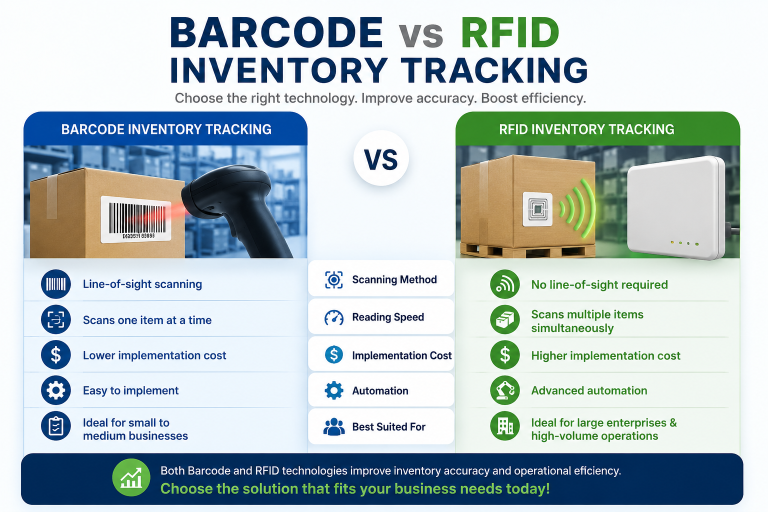
Choosing between Barcode Inventory Tracking and RFID Inventory Tracking depends on your business size, inventory volume, operational complexity, budget, and automation requirements. While both technologies improve inventory accuracy and operational efficiency, they differ significantly in implementation, performance, and scalability.
The comparison below helps businesses understand which solution best aligns with their inventory management goals.
| Feature | Barcode Inventory Tracking | RFID Inventory Tracking |
|---|---|---|
| Scanning Method | Requires line-of-sight scanning | No line-of-sight required |
| Reading Speed | One item at a time | Multiple items simultaneously |
| Inventory Accuracy | High | Very High |
| Initial Investment | Low | Higher |
| Barcode Labels | Required | Not Required |
| RFID Tags | Not Supported | Required |
| Hardware Cost | Lower | Higher |
| Inventory Visibility | Real-Time | Real-Time with Automated Detection |
| Warehouse Productivity | High | Very High |
| Multi-Warehouse Support | Yes | Yes |
| Asset Tracking | Limited | Advanced |
| Inventory Audits | Manual Scanning | Automated |
| Labor Requirement | Moderate | Low |
| Warehouse Automation | Partial | Extensive |
| Inventory Updates | Manual Scan Required | Automatic |
| ERP Integration | Supported | Supported |
| Scalability | Good | Excellent |
| Best for Small Businesses | Excellent | Moderate |
| Best for Large Enterprises | Good | Excellent |
| Manufacturing Operations | Good | Excellent |
| Distribution Centers | Good | Excellent |
When Should You Choose Barcode Inventory Tracking?
Barcode Inventory Tracking is the right choice if your business:
Has a limited implementation budget.
Requires reliable inventory tracking without complex infrastructure.
Manages small to medium-sized warehouses.
Performs manual receiving, picking, packing, and dispatch operations.
Wants to improve inventory accuracy with minimal investment.
Needs a proven inventory tracking solution that is easy to deploy and maintain.
Barcode technology is particularly suitable for retail businesses, wholesalers, distributors, warehouses, healthcare providers, and manufacturers beginning their inventory digital transformation journey.
Businesses looking for a complete barcode-enabled inventory solution can implement Barcode Inventory Management to improve stock accuracy, warehouse productivity, and operational efficiency.
When Should You Choose RFID Inventory Tracking?
RFID Inventory Tracking is recommended for organizations that:
Manage large warehouses or multiple facilities.
Handle high-value inventory.
Require automated inventory identification.
Need real-time inventory visibility without manual scanning.
Process thousands of inventory transactions daily.
Require high-speed warehouse operations and advanced inventory automation.
RFID technology is widely adopted across manufacturing, logistics, automotive, healthcare, electronics, and large distribution centers where operational speed and inventory visibility are business-critical.
Organizations seeking intelligent inventory automation can implement an RFID Inventory Tracking Systemto streamline inventory movement, reduce manual effort, and improve warehouse efficiency.
Which Solution is Better?
There is no single solution that fits every business.
Barcode Inventory Tracking provides an affordable, reliable, and scalable inventory management solution suitable for most small and medium-sized businesses.
RFID Inventory Tracking delivers advanced automation, faster inventory processing, and greater operational visibility for organizations with larger warehouse operations and higher inventory volumes.
Many growing businesses implement Barcode technology initially and later expand to RFID as operational complexity increases.
The best approach is selecting the technology that aligns with your operational requirements, inventory volume, business objectives, and future growth plans.
Not Sure Whether Barcode or RFID Is Right for Your Business?
Request a Free Demo • Get Expert Consultation • Talk to an Inventory Specialist
Industry Use Cases: Barcode vs RFID Inventory Tracking
Every business has different inventory management requirements. The right inventory tracking technology depends on inventory volume, warehouse size, operational complexity, compliance requirements, and future business growth.
Below are the most common industry use cases and recommendations.
Manufacturing
Manufacturing businesses manage raw materials, work-in-progress (WIP), finished goods, spare parts, and production inventory. Maintaining accurate inventory records is essential for uninterrupted production, efficient resource planning, and timely customer deliveries.
Barcode Inventory Tracking is ideal for manufacturers with small to medium production facilities because it provides accurate inventory updates at a lower implementation cost.
RFID Inventory Tracking is recommended for manufacturers operating multiple production lines or large facilities where automated inventory identification and real-time production visibility improve operational efficiency.
Manufacturers requiring complete production inventory visibility can implement Manufacturing Inventory Management Software to integrate inventory tracking, warehouse operations, production planning, and ERP systems.
Warehousing & Distribution
Warehouses process thousands of inventory transactions every day, including receiving, put-away, storage, picking, packing, transfers, and dispatch.
Barcode technology improves inventory accuracy by enabling warehouse staff to scan inventory at every operational stage.
RFID technology further enhances warehouse efficiency by automatically identifying inventory movement without manual scanning.
Businesses operating large warehouses can improve inventory visibility by integrating a Warehouse Management System with barcode or RFID technology.
Organizations managing multiple warehouse locations can also implement a Warehouse Tracking System to monitor inventory movement, warehouse locations, and order fulfillment in real time.
Retail & Wholesale
Retail businesses require fast inventory updates, accurate stock availability, and efficient replenishment.
Barcode systems are widely used in retail because they are cost-effective, easy to deploy, and integrate with POS systems.
Large retail chains and wholesale distributors managing thousands of SKUs often adopt RFID technology to reduce stock discrepancies and improve inventory accuracy across multiple stores and warehouses.
Logistics & Supply Chain
Logistics providers need complete visibility into inventory movement across warehouses, transportation hubs, and distribution centers.
Barcode technology provides reliable shipment verification, inventory transfers, and dispatch confirmation.
RFID technology enables automated shipment identification, real-time inventory movement tracking, and improved supply chain visibility.
Companies implementing advanced logistics automation frequently combine RFID technology with Inventory Control Software to improve inventory synchronization and stock accuracy.
Healthcare & Pharmaceuticals
Healthcare organizations manage medicines, medical equipment, laboratory supplies, and high-value assets where inventory accuracy is critical.
Barcode systems support medication verification, inventory audits, and stock management.
RFID solutions provide automated tracking of medical assets, reducing manual inventory processes while improving compliance and traceability.
Which Technology Fits Your Business?
| Business Type | Recommended Solution |
|---|---|
| Small Retail Store | Barcode Inventory Tracking |
| Wholesale Distributor | Barcode + Inventory Management Software |
| Manufacturing Company | Barcode or RFID (based on production scale) |
| Large Manufacturing Plant | RFID Inventory Tracking |
| Warehouse | Barcode + Warehouse Management System |
| Distribution Center | RFID + Warehouse Management System |
| Logistics Company | RFID + Inventory Control Software |
| Healthcare Organization | RFID Inventory Tracking |
| Multi-Warehouse Business | RFID + Warehouse Tracking System |
Choosing the right inventory tracking solution should be based on operational requirements, budget, warehouse complexity, inventory volume, and long-term business objectives. Many growing organizations begin with barcode technology and later expand to RFID as operational demands increase.
Industry Use Cases: Barcode vs RFID Inventory Tracking
Every business has different inventory management requirements. The right inventory tracking technology depends on inventory volume, warehouse size, operational complexity, compliance requirements, and future business growth.
Below are the most common industry use cases and recommendations.
Manufacturing
Manufacturing businesses manage raw materials, work-in-progress (WIP), finished goods, spare parts, and production inventory. Maintaining accurate inventory records is essential for uninterrupted production, efficient resource planning, and timely customer deliveries.
Barcode Inventory Tracking is ideal for manufacturers with small to medium production facilities because it provides accurate inventory updates at a lower implementation cost.
RFID Inventory Tracking is recommended for manufacturers operating multiple production lines or large facilities where automated inventory identification and real-time production visibility improve operational efficiency.
Manufacturers requiring complete production inventory visibility can implement Manufacturing Inventory Management Software to integrate inventory tracking, warehouse operations, production planning, and ERP systems.
Warehousing & Distribution
Warehouses process thousands of inventory transactions every day, including receiving, put-away, storage, picking, packing, transfers, and dispatch.
Barcode technology improves inventory accuracy by enabling warehouse staff to scan inventory at every operational stage.
RFID technology further enhances warehouse efficiency by automatically identifying inventory movement without manual scanning.
Businesses operating large warehouses can improve inventory visibility by integrating a Warehouse Management Systemwith barcode or RFID technology.
Organizations managing multiple warehouse locations can also implement a Warehouse Tracking System to monitor inventory movement, warehouse locations, and order fulfillment in real time.
Retail & Wholesale
Retail businesses require fast inventory updates, accurate stock availability, and efficient replenishment.
Barcode systems are widely used in retail because they are cost-effective, easy to deploy, and integrate with POS systems.
Large retail chains and wholesale distributors managing thousands of SKUs often adopt RFID technology to reduce stock discrepancies and improve inventory accuracy across multiple stores and warehouses.
Logistics & Supply Chain
Logistics providers need complete visibility into inventory movement across warehouses, transportation hubs, and distribution centers.
Barcode technology provides reliable shipment verification, inventory transfers, and dispatch confirmation.
RFID technology enables automated shipment identification, real-time inventory movement tracking, and improved supply chain visibility.
Companies implementing advanced logistics automation frequently combine RFID technology with Inventory Control Softwareto improve inventory synchronization and stock accuracy.
Healthcare & Pharmaceuticals
Healthcare organizations manage medicines, medical equipment, laboratory supplies, and high-value assets where inventory accuracy is critical.
Barcode systems support medication verification, inventory audits, and stock management.
RFID solutions provide automated tracking of medical assets, reducing manual inventory processes while improving compliance and traceability.
Which Technology Fits Your Business?
| Business Type | Recommended Solution |
|---|---|
| Small Retail Store | Barcode Inventory Tracking |
| Wholesale Distributor | Barcode + Inventory Management Software |
| Manufacturing Company | Barcode or RFID (based on production scale) |
| Large Manufacturing Plant | RFID Inventory Tracking |
| Warehouse | Barcode + Warehouse Management System |
| Distribution Center | RFID + Warehouse Management System |
| Logistics Company | RFID + Inventory Control Software |
| Healthcare Organization | RFID Inventory Tracking |
| Multi-Warehouse Business | RFID + Warehouse Tracking System |
Choosing the right inventory tracking solution should be based on operational requirements, budget, warehouse complexity, inventory volume, and long-term business objectives. Many growing organizations begin with barcode technology and later expand to RFID as operational demands increase.
Need Help Choosing Between Barcode and RFID?
Request a Free Demo • Book a Consultation • Talk to an Inventory Expert
How to Choose the Right Inventory Tracking Solution for Your Business
Selecting the right inventory tracking solution is a strategic business decision that affects inventory accuracy, warehouse productivity, operational efficiency, and long-term business growth. While both Barcode and RFID technologies provide reliable inventory tracking, the most suitable solution depends on your operational requirements rather than choosing the most advanced technology.
Before investing in an inventory tracking system, businesses should evaluate their inventory volume, warehouse size, operational complexity, future expansion plans, and available budget.
Choose Barcode Inventory Tracking If You:
Barcode Inventory Tracking is recommended for organizations that require a reliable and cost-effective inventory management solution.
Barcode technology is ideal when your business:
Operates a small or medium-sized warehouse
Manages a limited inventory volume
Requires affordable implementation costs
Performs manual inventory receiving and dispatch
Wants to improve inventory accuracy quickly
Requires barcode label printing and scanning
Needs simple ERP integration
Plans to digitize inventory processes gradually
Many growing businesses implement Barcode Inventory Management as the first step toward warehouse automation because it offers an excellent balance between investment and operational efficiency.
Choose RFID Inventory Tracking If You:
RFID Inventory Tracking is recommended for organizations requiring advanced automation and real-time inventory visibility.
RFID technology is suitable when your business:
Operates multiple warehouses
Processes thousands of inventory transactions daily
Requires automated inventory identification
Handles high-value inventory or assets
Needs real-time warehouse visibility
Wants faster inventory audits
Requires contactless inventory tracking
Plans large-scale warehouse automation
Organizations implementing RFID Inventory Tracking System solutions often improve warehouse productivity while reducing manual labor and inventory discrepancies.
Consider a Hybrid Barcode + RFID Solution
Many organizations do not need to choose one technology exclusively.
A hybrid approach combines Barcode and RFID technologies to maximize operational efficiency.
For example:
Barcode for receiving and shipping
RFID for warehouse movement tracking
Barcode for inventory labeling
RFID for high-value assets
Barcode for production inventory
RFID for automated warehouse monitoring
This approach allows businesses to optimize costs while gradually introducing warehouse automation.
Additional Factors to Consider
Before making your decision, evaluate the following:
Business Size
Small and medium businesses often benefit from barcode systems due to lower implementation costs and easier deployment.
Inventory Volume
Businesses handling large inventory volumes may benefit from RFID because multiple items can be identified automatically.
Warehouse Complexity
Simple warehouse operations may require only barcode scanning, while complex distribution centers often benefit from RFID automation.
Budget
Barcode systems generally require a lower upfront investment. RFID solutions may involve higher initial costs but can provide greater efficiency in suitable environments.
Future Growth
Businesses planning to expand warehouses, increase inventory volumes, or automate operations should consider how well the chosen solution can scale over time.
Expert Recommendation
There is no universally “best” inventory tracking technology.
Barcode Inventory Tracking is an excellent choice for organizations seeking a dependable, cost-effective solution that improves inventory accuracy and operational efficiency.
RFID Inventory Tracking is better suited to organizations that need higher levels of automation, rapid inventory identification, and real-time visibility across large or complex operations.
The right solution should align with your operational goals, inventory processes, available budget, and long-term business strategy.
Many businesses achieve the best results by integrating Barcode or RFID technology with Inventory Management Software, Inventory Control Software, and a Warehouse Management System to create a centralized inventory management platform.
Frequently Asked Questions (FAQ)
1. What is the difference between Barcode and RFID Inventory Tracking?
Barcode Inventory Tracking requires a barcode scanner to read each barcode individually using line-of-sight scanning. RFID Inventory Tracking uses radio waves to identify tagged inventory automatically without requiring direct line-of-sight. Barcode is generally more cost-effective for small and medium businesses, while RFID is suitable for organizations requiring advanced automation and real-time inventory visibility.
2. Which inventory tracking solution is better for small businesses?
For most small and medium-sized businesses, Barcode Inventory Tracking is often the preferred option because it has lower implementation costs, is easier to deploy, and significantly improves inventory accuracy. As businesses grow, they may consider RFID technology to support larger-scale operations.
3. Can Barcode and RFID be used together?
Yes. Many organizations implement a hybrid solution where barcode technology is used for receiving, shipping, and inventory labeling, while RFID is used for automated warehouse tracking, high-value assets, or large-scale inventory monitoring. This approach helps balance operational efficiency and investment costs.
4. Does RFID completely replace barcode systems?
Not necessarily. RFID and barcode technologies serve different operational needs. Many businesses continue to use barcode systems because they are cost-effective and reliable. RFID is often introduced where faster inventory identification, automation, or large inventory volumes justify the additional investment.
5. Which industries benefit most from RFID Inventory Tracking?
RFID is commonly used in manufacturing, warehousing, logistics, healthcare, automotive, retail, and distribution centers where organizations require real-time inventory visibility, automated inventory identification, and improved warehouse efficiency.
6. How does Barcode Inventory Tracking improve inventory accuracy?
Barcode technology reduces manual data entry by allowing inventory items to be scanned during receiving, storage, production, picking, packing, and dispatch. This helps maintain accurate inventory records and minimizes stock discrepancies.
7. Can Barcode and RFID integrate with ERP systems?
Yes. Both Barcode and RFID solutions can integrate with ERP platforms to synchronize inventory, purchasing, production, warehouse operations, and sales information, providing a centralized view of business operations.
8. How do I choose the right inventory tracking solution?
The right solution depends on several factors, including:
Inventory volume
Warehouse size
Operational complexity
Available budget
Required automation level
Future business growth
ERP integration requirements
Evaluating these factors helps businesses select the technology that best aligns with their operational goals.
9. What is the implementation time for Barcode or RFID Inventory Tracking?
Implementation time varies depending on the size of the business, the number of warehouse locations, the complexity of inventory processes, and integration requirements. Smaller barcode deployments can often be completed more quickly than enterprise-scale RFID implementations.
10. Why choose SAMCO for Inventory Tracking Solutions?
SAMCO provides Barcode Inventory Management, RFID Inventory Tracking, Inventory Management Software, Warehouse Management Systems, and ERP-integrated inventory solutions tailored to manufacturing, warehousing, logistics, retail, and distribution businesses across the UAE. Our approach focuses on improving inventory accuracy, operational visibility, and warehouse efficiency through solutions matched to each organization’s needs.
Ready to Improve Your Inventory Accuracy?
Whether you’re evaluating Barcode Inventory Tracking, RFID Inventory Tracking, or a complete Inventory Management Software solution, choosing the right technology can improve inventory visibility, reduce manual errors, and support long-term business growth.
Why Choose SAMCO?
Barcode & RFID Implementation
Inventory Management Software
Warehouse Management System Integration
ERP Integration
Multi-Warehouse Inventory Management
Real-Time Inventory Reporting
UAE-Based Implementation & Support
Related Inventory Management Solutions
Businesses looking to improve inventory visibility and warehouse efficiency may also benefit from the following inventory management solutions.
Inventory Management Software
Centralize inventory tracking, warehouse operations, purchasing, sales, and reporting from a single platform with Inventory Management Software.
Inventory Control Software
Improve stock accuracy, automate reorder points, reduce inventory shortages, and optimize inventory levels using Inventory Control Software.
Barcode Inventory Management
Implement barcode scanning to improve inventory accuracy, warehouse productivity, and inventory visibility.
RFID Inventory Tracking System
Automate inventory identification and improve warehouse visibility using RFID technology.
Warehouse Management System
Optimize receiving, storage, picking, packing, dispatch, and warehouse operations using a Warehouse Management System.
Warehouse Tracking System
Track inventory movement across warehouses and storage locations in real time.
Manufacturing Inventory Management Software
Manage raw materials, work-in-progress inventory, and finished goods with inventory software designed for manufacturers.
Factory Inventory Management Software
Improve production inventory control, warehouse visibility, and manufacturing efficiency.
Warehouse Automation Solutions
Automate warehouse workflows, inventory movement, and order fulfillment to improve operational efficiency.
Industry Standards & Resources
Businesses implementing inventory tracking technologies can refer to the following industry resources for barcode and RFID standards.
Why Businesses Choose SAMCO
Organizations across manufacturing, warehousing, logistics, retail, and distribution require inventory solutions that improve operational visibility while supporting future business growth.
SAMCO delivers inventory management solutions tailored to each organization’s operational requirements through:
Inventory Management Software
Barcode Inventory Management
RFID Inventory Tracking
Warehouse Management Systems
Inventory Control Software
ERP Integration
Multi-Warehouse Management
Inventory Analytics & Reporting
UAE Implementation & Support
Ready to Modernize Your Inventory Operations?
Whether you’re considering Barcode Inventory Tracking, RFID Inventory Tracking, or a complete Inventory Management Software solution, SAMCO can help you choose and implement the right technology for your business.


