

Inventory Management Software for Manufacturing, Warehouses & Distributors
Gain Complete Control Over Inventory, Warehouse Operations, and Stock Movement
Inventory is one of the most valuable assets for manufacturers, warehouses, distributors, and supply chain businesses. Yet many organizations continue to struggle with stock discrepancies, inventory shortages, excess inventory, manual processes, and limited visibility across operations.
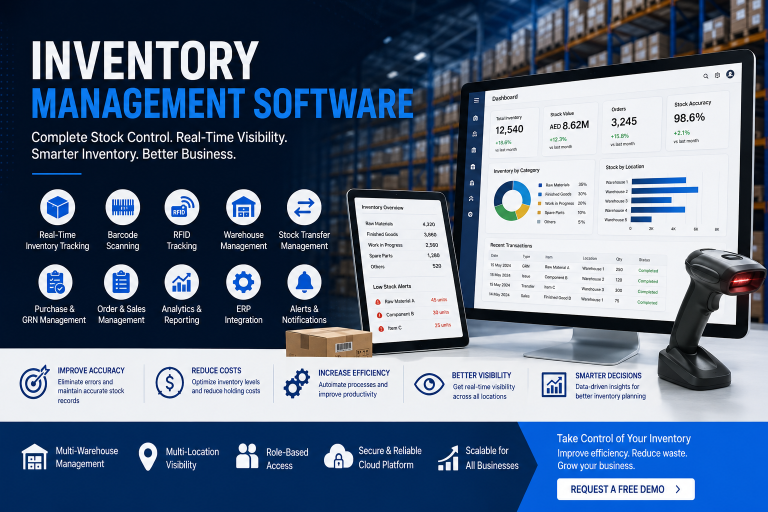
Inventory Management Software helps businesses track inventory in real time, automate stock control processes, improve warehouse efficiency, and maintain accurate inventory records throughout the supply chain.
Whether you manage raw materials, work-in-progress inventory, finished goods, spare parts, or multiple warehouse locations, a modern inventory management system provides complete visibility and control over inventory operations.
Businesses looking for advanced warehouse visibility often combine inventory management with a warehouse tracking system to improve inventory accuracy and operational efficiency.
What is Inventory Management Software?
Inventory Management Software is a digital solution that helps organizations monitor, control, optimize, and analyze inventory throughout its lifecycle.
The system provides real-time visibility into inventory quantities, warehouse locations, stock movement, purchasing activities, production consumption, and dispatch operations.
Instead of relying on spreadsheets or manual inventory records, businesses gain instant access to accurate inventory data from a centralized platform.
Key capabilities include:
Inventory tracking
Stock control
Warehouse management
Barcode scanning
RFID tracking
Inventory analytics
ERP integration
Inventory forecasting
Supply chain visibility
Inventory management software plays a critical role in improving operational performance, reducing costs, and supporting business growth.
Inventory Management Software Dubai
Why Inventory Management Matters
Poor inventory control creates challenges across purchasing, warehousing, production, and customer fulfillment.
Inventory Management Best Practices
Common problems include:
Inventory Inaccuracy
Incorrect stock records result in purchasing mistakes, production delays, and order fulfillment issues.
Overstocking
Excess inventory increases storage costs and ties up valuable working capital.
Stock Shortages
Insufficient inventory can disrupt production schedules and impact customer satisfaction.
Manual Processes
Spreadsheet-based inventory management increases errors and reduces operational efficiency.
Lack of Visibility
Businesses struggle to identify inventory availability, location, and movement without centralized systems.
Modern inventory management software eliminates these challenges through automation and real-time visibility.
Real-Time Inventory Tracking
Real-time inventory tracking provides instant access to inventory information across warehouses, facilities, and distribution centers.
Every inventory transaction is recorded automatically, creating accurate inventory records throughout the organization.
Key features include:
Live inventory visibility
Inventory movement tracking
Stock transfer monitoring
Multi-location inventory management
Inventory transaction history
Inventory audit trails
Benefits
Faster inventory decisions
Reduced stock discrepancies
Improved inventory accuracy
Better warehouse productivity
Improved customer service
Real-time visibility enables organizations to respond quickly to changing inventory requirements.
Inventory Control Software
Inventory control is the process of maintaining optimal inventory levels while minimizing waste and operational inefficiencies.
Inventory control software helps businesses:
Monitor stock levels
Manage reorder points
Reduce excess inventory
Prevent stock shortages
Improve inventory turnover
Optimize purchasing decisions
Effective inventory control improves profitability while ensuring inventory availability.
Warehouse Management System Integration
Inventory and warehouse operations are closely connected.
A Warehouse Management System (WMS) improves warehouse productivity by optimizing inventory movement, storage, and fulfillment processes.
Core warehouse management functions include:
Goods Receiving
Track inbound inventory and update stock records automatically.
Putaway Management
Assign inventory to the most appropriate warehouse locations.
Bin and Location Tracking
Monitor inventory at warehouse, zone, rack, shelf, and bin levels.
Order Picking
Improve order accuracy and fulfillment speed.
Dispatch Management
Track outbound inventory from warehouse staging to customer delivery.
Organizations requiring advanced warehouse visibility often implement a warehouse tracking system alongside inventory management software.
Barcode Inventory Management
Barcode technology simplifies inventory transactions while improving accuracy.
Warehouse operators can use barcode scanners to process inventory quickly and efficiently.
Barcode-supported activities include:
Receiving inventory
Inventory transfers
Stock audits
Picking operations
Dispatch confirmation
Cycle counting
Benefits of Barcode Tracking
Faster processing
Reduced manual errors
Improved inventory visibility
Better warehouse productivity
Higher inventory accuracy
Barcode inventory management is widely used across manufacturing, warehousing, retail, and distribution industries.
RFID Inventory Tracking
RFID technology enables automatic inventory identification and tracking without manual barcode scanning.
RFID tags provide real-time inventory visibility and improve inventory traceability.
RFID inventory tracking supports:
Asset tracking
Inventory movement monitoring
Warehouse visibility
Inventory automation
Supply chain traceability
Businesses managing large inventory volumes often use RFID solutions to improve operational efficiency.
RFID Inventory Tracking System
Manufacturing Inventory Management
Manufacturers require specialized inventory management capabilities to support production operations.
Raw Material Management
Track inventory used for production activities.
Work-in-Progress Inventory
Monitor materials consumed during manufacturing processes.
Finished Goods Inventory
Track completed products through storage and dispatch.
Production Visibility
Provide inventory information to production planners and operational teams.
Manufacturing inventory management improves production efficiency while reducing inventory-related disruptions.
Factory Inventory Management Software
Manufacturing Inventory Management Software
Warehouse Automation
Warehouse automation improves productivity by reducing manual processes and streamlining workflows.
Automation capabilities include:
Inventory updates
Warehouse transactions
Stock movement recording
Inventory alerts
Order processing
Dispatch workflows
Organizations seeking to automate inventory operations can benefit from our business process automation solutions that improve efficiency and reduce operational bottlenecks.
Benefits of Automation
Lower labor costs
Faster operations
Improved accuracy
Better scalability
Enhanced operational visibility
Warehouse Automation Solutions
ERP Integration
Inventory software becomes significantly more powerful when integrated with enterprise systems.
ERP integration ensures inventory information remains synchronized across departments.
Integration capabilities include:
Purchase orders
Inventory updates
Goods receipts
Production transactions
Dispatch confirmations
Inventory reporting
Reliable inventory management depends on secure infrastructure and connectivity. Businesses can strengthen operational performance through our IT infrastructure solutions UAE and enterprise-grade network solutions UAE.
Inventory Analytics and Reporting
Inventory decisions should be driven by data, not assumptions.
Inventory analytics provides insights into:
Inventory turnover
Inventory valuation
Stock movement trends
Warehouse performance
Inventory aging
Replenishment planning
Inventory forecasting
Organizations looking to improve forecasting accuracy can explore our predictive analytics solutions to support data-driven inventory planning.
Cloud, Security & Data Management
Modern inventory operations require secure, reliable, and scalable technology infrastructure.
Our inventory management platform supports secure inventory storage, centralized access, and business continuity across multiple locations.
Organizations requiring enhanced reliability can benefit from secure data storage solutions that support inventory systems and operational applications.
Benefits
Secure inventory records
Reliable data access
Improved business continuity
Reduced downtime
Centralized inventory visibility
Supply Chain Visibility
Inventory management plays a critical role in overall supply chain performance.
Businesses can improve:
Procurement planning
Inventory forecasting
Warehouse operations
Distribution management
Customer fulfillment
Better inventory visibility enables organizations to make faster and more informed decisions across the supply chain.
Industries We Serve
Manufacturing
Manage raw materials, work-in-progress inventory, and finished goods.
Warehousing and Distribution
Improve inventory visibility and warehouse efficiency.
Food and Beverage
Support inventory traceability and FIFO inventory management.
Automotive
Track components, assemblies, and finished products.
Electronics
Manage high-value inventory with complete visibility and control.
Retail and Trading
Monitor inventory across multiple locations and sales channels.
Why Choose SAMCO?
SAMCO provides technology solutions designed to help businesses improve inventory visibility, warehouse efficiency, and operational performance.
Our solution combines:
Inventory Management Software
Warehouse Management System capabilities
Barcode inventory tracking
RFID inventory management
Inventory analytics
ERP integration
Multi-location inventory visibility
Warehouse automation
Organizations requiring specialized workflows and intelligent automation can also explore our custom AI development services for advanced business solutions.
Frequently Asked Questions
What is inventory management software?
Inventory management software helps businesses track, control, and optimize inventory across warehouses, manufacturing facilities, and distribution operations.
How does inventory management software improve inventory accuracy?
The system records inventory transactions automatically, reducing manual errors and improving stock visibility.
Does inventory software support barcode tracking?
Yes. Barcode scanning can be used for receiving, transfers, picking, audits, and dispatch operations.
Does inventory software support RFID technology?
Yes. RFID tracking provides automated inventory visibility and improved traceability.
Can inventory software integrate with ERP systems?
Yes. ERP integration synchronizes inventory information across procurement, production, finance, and sales departments.
Is inventory management software suitable for manufacturers?
Yes. Manufacturers use inventory software to manage raw materials, work-in-progress inventory, and finished goods.
Request a Free Demo
Discover how Inventory Management Software can help your organization improve inventory accuracy, automate warehouse operations, and gain complete visibility into stock movement.
Speak with our specialists today to schedule a personalized demonstration and learn how our inventory management solution can support your manufacturing, warehouse, and supply chain operations.
Request a Free Demo
Get Pricing
Talk to an Inventory Expert


