

Artificial Intelligence Solutions in UAE
SAMCO Technology - AI Solutions UAE delivering custom AI development, chatbots, RPA, and predictive analytics to automate, scale, and transform business operations.Get Your Business Suitable AI Solutions in UAE
SAMCO provides AI solutions designed around specific business requirements, operational challenges, customer needs, data, and existing technology. We help businesses identify practical opportunities for artificial intelligence, define the right solution, integrate it with relevant systems, and prepare it for real-world use.
Whether you need to improve business processes, use data more effectively, support customers, develop an intelligent application, or introduce AI into an existing workflow, the right approach starts with the business problem rather than the technology alone.
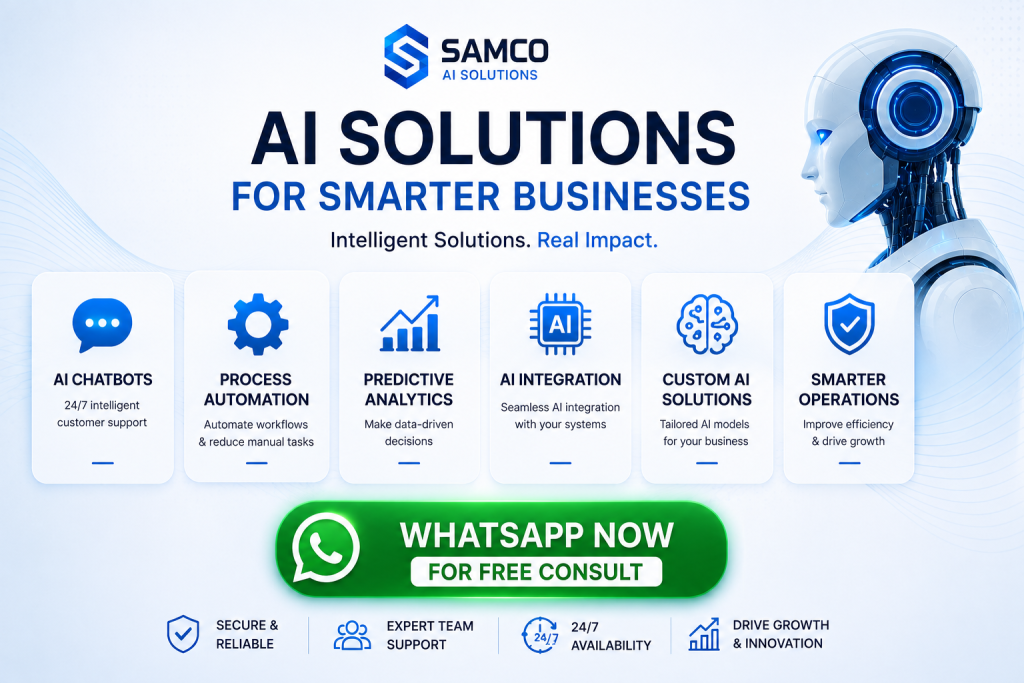
What Are AI Solutions?
AI solutions are business-focused applications of artificial intelligence designed to solve specific problems or improve how a business operates.
An artificial intelligence solution may use AI models, business data, knowledge sources, software applications, APIs, databases, or existing business systems depending on the requirement.
The purpose is to apply AI where it can provide practical value, such as:
Improving operational efficiency
Supporting customer interactions
Processing business information
Analysing data
Supporting business decisions
Reducing repetitive work
Building intelligent applications
Improving existing business processes
The appropriate solution depends on the business objective, available data, existing systems, users, security requirements, and expected outcome.
Our AI Solutions Portfolio
SAMCO approaches AI as a collection of practical business capabilities rather than a single technology.
AI Automation
AI can be applied to suitable repetitive processes and workflows to reduce manual effort and improve operational efficiency.
For businesses looking specifically to automate processes using AI, explore our AI automation service.
AI Consulting
Before implementation, a business may need to identify suitable AI opportunities, evaluate its current environment, and define a practical implementation approach.
AI consulting can help establish:
- Business objectives
- Suitable use cases
- Data requirements
- Technology requirements
- Integration requirements
- Implementation priorities
AI Virtual Assistant
An AI virtual assistant can support customers or employees by providing business information, answering questions, and assisting with defined tasks.
The assistant’s capabilities depend on its knowledge, integrations, permissions, and the workflows it is designed to support.
AI Development
Some businesses need AI capabilities built into a custom application or software environment.
This can involve AI-powered functionality, business data, APIs, databases, and application interfaces designed around a specific requirement.
For dedicated AI development requirements, explore our AI development company service.
AI Chatbot Solutions
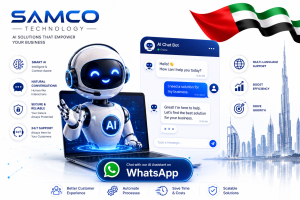
Businesses can use conversational AI to provide information and assist users through defined conversational experiences.
The appropriate chatbot architecture depends on the intended users, information sources, channels, integrations, and required capabilities. Explore Service for AI Chatbot
AI Customer Service
AI can also support customer-service operations by handling suitable enquiries, providing information, qualifying requests, and routing conversations to human teams when required.
The objective is to support customer-service teams with appropriate AI capabilities rather than remove the need for human judgement in every interaction.
Artificial Intelligence Solutions for Different Business Needs
Different businesses require different applications of AI.
A useful AI implementation starts by identifying the problem that needs to be solved and then selecting the appropriate technology.
Improve Operational Efficiency
Businesses can use AI to identify repetitive activities, information-heavy processes, and areas where employees spend significant time handling routine work.
The resulting solution may involve AI-assisted processing, automation, information retrieval, or another approach depending on the process.
Improve Customer Experience
AI can make relevant business information easier for customers to access and support suitable customer interactions.
This may help businesses provide assistance across selected channels while allowing human teams to handle complex requests.
Process Business Information
AI can help businesses work with documents, knowledge sources, structured information, and other business content.
The implementation can be designed around the information sources that the organisation approves for use.
Support Business Decisions
Where sufficient and suitable data is available, AI can help identify patterns, generate insights, and support business decision-making.
AI should support decision-making with relevant information rather than replace appropriate human judgement.
Build Intelligent Business Applications
AI capabilities can be incorporated into software applications when a business needs functionality that is not available through a standard solution.
The application can be designed around the required users, data, workflows, integrations, and business objectives.
AI Business Applications
AI business applications can take many forms because artificial intelligence can be applied to different types of business information and processes.
Examples include:
Customer information assistance
Internal knowledge access
Data analysis
Document processing
Customer enquiry handling
Lead qualification
Business information retrieval
Decision support
Intelligent application features
Process assistance
The best application is the one that addresses a clearly defined business requirement and can be supported by the available data and technology.
Enterprise AI Solutions
Enterprise AI solutions require more than selecting an AI model.
An enterprise implementation may need to consider:
Existing technology
Business data
System integrations
Security
Access permissions
Scalability
Governance
User roles
Monitoring
Business continuity
AI should fit into the organisation’s existing technology environment and operating requirements.
Enterprise Data and Access
Access to business information should be controlled according to user roles and permissions.
The solution should only use information and systems that have been approved for the intended use case.
Enterprise Integration
AI may need to work with existing applications, databases, APIs, CRM systems, internal tools, or other business platforms.
Integration requirements should therefore be assessed before implementation.
Enterprise Scalability
A solution should be designed around expected users, workloads, data requirements, and future business needs.
Custom AI Solutions
Not every business has the same processes, information, users, or technology environment.
A custom AI solution can be designed around the requirements of the organisation rather than forcing the business into a fixed workflow.
Depending on the project, customisation may involve:
AI models
Business knowledge
Data sources
APIs
Databases
Application interfaces
Business workflows
User permissions
Existing software
The right level of customisation depends on the business requirement.
AI Marketing Solutions
AI marketing solutions can support selected marketing activities where AI can provide useful assistance.
Potential applications include:
Customer insights
Marketing analysis
Content assistance
Personalisation
Lead support
Campaign analysis
The appropriate implementation depends on the business’s marketing processes, available data, technology environment, and objectives.
For businesses with a specific marketing automation requirement, a dedicated marketing automation implementation can be evaluated separately.
How We Implement AI Solutions
A successful AI project should begin with the business requirement and progress through structured implementation.
1. Understand the Business Requirement
We identify:
The problem
Current process
Target users
Business objective
Expected outcome
Existing technology
2. Identify the AI Opportunity
We determine where AI can provide practical value and whether AI is appropriate for the identified problem.
3. Define the Solution
The solution is defined around:
Required AI capabilities
Data
Knowledge sources
Users
Workflows
Integrations
Security requirements
4. Design the Experience
User interactions, system behaviour, information flow, permissions, and required workflows are defined before implementation.
5. Develop and Integrate
The required solution is built or configured and connected to appropriate business systems where suitable integrations are available.
6. Test
Testing can cover:
Response quality
Data handling
System behaviour
User experience
Integrations
Permissions
Edge cases
7. Deploy
After the required testing, the solution can be prepared for deployment in the intended business environment.
8. Improve
AI solutions can be reviewed after deployment to identify opportunities to improve knowledge, workflows, responses, integrations, and overall performance.
AI Solution Integration
AI becomes more useful when it can work with the information and systems required for the business use case.
Depending on the project, integrations may involve:
CRM systems
Databases
APIs
Websites
Internal applications
Helpdesk systems
Business software
Communication channels
Integration availability depends on the technical capabilities of the existing system, access permissions, APIs, security requirements, and the desired workflow.
AI Solutions for UAE Businesses
Businesses in the UAE can have different operational, customer, language, technology, and integration requirements.
An AI solution can be planned around factors such as:
Business processes
Customer requirements
Arabic and English user experiences where required
Existing software
Business data
Security
Integration
Scalability
The implementation should be based on the individual business requirement rather than assuming that the same AI solution is appropriate for every organisation.
Why Choose SAMCO for AI Solutions?
AI implementation should begin with a business objective rather than a technology trend.
SAMCO focuses on understanding the requirement, identifying practical AI opportunities, defining the appropriate solution, and planning the technology and integration requirements needed to implement it.
Our approach focuses on:
Business-first AI planning
Practical use cases
Custom solution design
Business data and knowledge
System integration
Structured testing
Deployment
Ongoing improvement
The objective is to build an AI solution that has a clear purpose, appropriate capabilities, and a defined role within the business.
AI Solutions FAQs
What are AI solutions?
AI solutions are applications of artificial intelligence designed to solve specific business problems. They can support areas such as automation, customer experience, data analysis, information processing, decision support, and intelligent business applications.
How can AI solutions help a business?
AI can help businesses process information, support customers, analyse data, reduce repetitive work, improve selected processes, and build intelligent applications. The actual benefit depends on the business problem, available data, and implementation.
What are examples of AI business applications?
Examples include customer assistance, information retrieval, document processing, data analysis, decision support, lead qualification, internal knowledge assistance, and AI-powered application functionality.
Can AI solutions be customised?
Yes. An AI solution can be designed around a business’s processes, data, users, systems, and objectives. The required level of customisation depends on the use case.
Can AI solutions integrate with existing business systems?
Yes, where the existing systems provide suitable integration capabilities and the required technical access and permissions are available.
What are enterprise AI solutions?
Enterprise AI solutions are AI implementations designed to work within larger organisational environments where factors such as data, security, access control, integration, scalability, governance, and user management need to be considered.
Can AI solutions support customer experience?
Yes. AI can support customer information requests, assistance, lead qualification, personalisation, and defined customer-service workflows.
Can AI solutions support business automation?
Yes. AI can be applied to suitable repetitive or information-heavy processes. The appropriate automation approach depends on the process and the systems involved.
How much do AI solutions cost in UAE?
There is no single fixed price. Cost depends on the solution’s scope, complexity, data requirements, integrations, security requirements, development work, deployment environment, and ongoing support.
How long does an AI solution take to implement?
The timeline depends on the complexity of the solution, the amount of development required, data preparation, integrations, testing, and deployment requirements.
Which AI solution is right for my business?
The right solution depends on the business problem, desired outcome, users, available data, existing systems, and required capabilities. A structured discovery process can help identify the appropriate approach.
How do I start an AI project?
Start by defining the business problem, the people affected by it, the desired outcome, the information involved, and the systems currently used. These requirements can then be assessed to determine an appropriate AI solution.
Build the Right AI Solution for Your Business
AI works best when it is connected to a clear business requirement.
Tell SAMCO what you want to improve, automate, analyse, support, or build. We can help define the appropriate AI approach, required capabilities, integrations, and implementation path.
Discuss Your AI Requirement on WhatsApp


