

AI Virtual Assistant Services in UAE
Take your AI Virtual Assistant in UAE
SAMCO helps businesses build AI virtual assistants that can answer questions, provide business information, assist customers and employees, support routine requests, and connect with selected business systems.
A custom AI virtual assistant can be designed around your business knowledge, users, workflows, communication channels, and defined tasks. The objective is not simply to create another chatbot, but to provide an AI assistant that can deliver useful assistance within a clearly defined business environment.
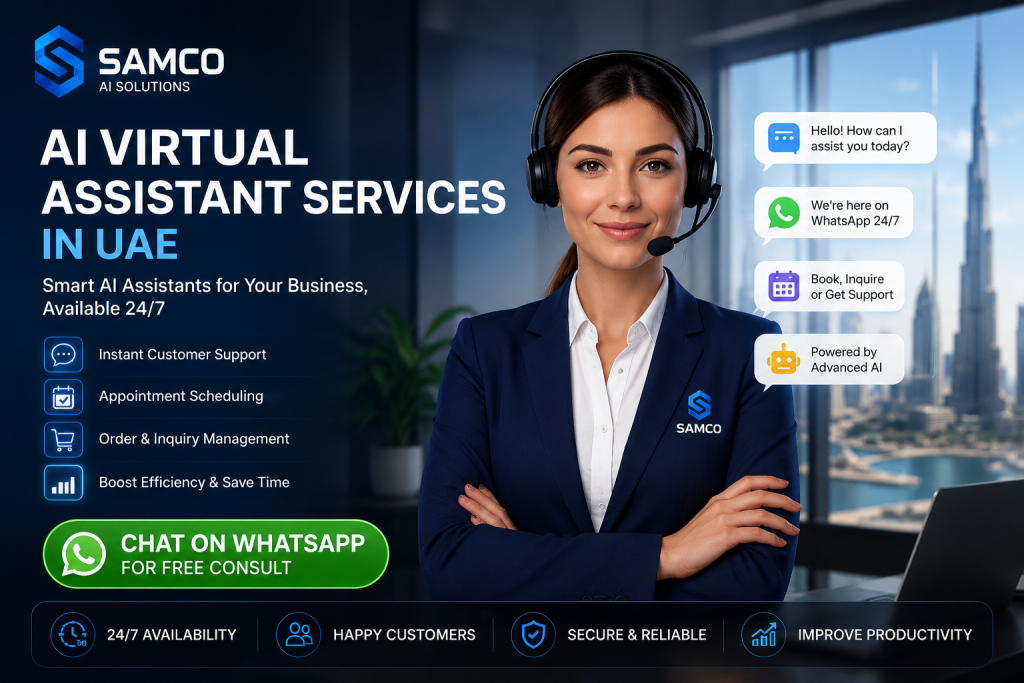
Custom AI Virtual Assistant Solutions
A custom AI assistant can be designed around the information, processes, and requirements of your business.
Instead of relying only on generic responses, the assistant can be configured to work with approved business knowledge and provide assistance based on the use case you define.
Depending on the requirements, an AI virtual assistant can support:
Customer questions
Employee questions
Business information
Knowledge retrieval
Routine requests
Lead qualification
Appointment-related requests
Defined business tasks
System interactions
Human handoff
The exact capabilities depend on the information, systems, integrations, permissions, and tasks included in the implementation.
What Can an AI Virtual Assistant Do?
An AI virtual assistant can do more than provide simple conversational responses when it is connected to appropriate business knowledge and systems.
Answer Customer Questions
The assistant can provide information about:
Products
Services
Policies
Frequently asked questions
Business information
Availability
General customer enquiries
This allows customers to get answers without requiring a team member to respond to every routine question manually.
Assist Employees
An AI virtual assistant can also support internal teams by helping employees find approved business information.
It can assist with:
Internal policies
Procedures
Business documents
Knowledge bases
Product information
Process information
Routine information requests
Employees can interact with the information conversationally instead of manually searching through multiple sources.
Retrieve Business Information
A virtual assistant can be connected to selected business information sources so users can ask questions using natural language.
For example, employees or customers may ask for information that would otherwise require searching through documents, websites, or approved knowledge bases.
Handle Routine Requests
Depending on the implementation, the assistant can support defined requests such as:
Appointment enquiries
Service enquiries
Lead qualification
Status requests
Information requests
Basic customer support
The assistant should only perform actions that have been clearly defined and appropriately connected.
Perform Defined Tasks
An AI virtual assistant can be designed to perform specific tasks when the required tools, integrations, permissions, and workflows are available.
This can move the assistant beyond answering questions toward practical business assistance.
AI Virtual Assistant for Customer Support
AI customer support can help businesses respond to repetitive customer enquiries and provide information consistently.
A virtual assistant can support customer-facing teams by handling suitable requests before involving a human employee.
24/7 Customer Assistance
An AI virtual assistant can remain available outside normal working hours, allowing customers to receive assistance when a team member may not be available.
The quality of the response depends on the assistant’s configured knowledge and capabilities.
Customer Enquiry Handling
The assistant can help customers find information about:
Products
Services
Processes
Frequently asked questions
Business policies
Next steps
Lead Qualification
Where appropriate, the assistant can collect defined information from potential customers and help identify enquiries that should be passed to the sales team.
Human Handoff
Not every request should be handled by AI.
A virtual assistant can be designed to transfer a conversation to a human when:
The request is complex
The assistant does not have enough information
Human approval is required
The customer requests a person
The situation requires specialised attention
Relevant conversation information can be passed to the appropriate team where the integration supports it.
AI Virtual Assistant for Employees
Businesses can also use AI assistants internally.
An employee-facing assistant can help staff access approved information without requiring them to search through multiple documents or systems manually.
Internal Knowledge Assistance
Employees can use the assistant to find information from approved sources such as:
Policies
Procedures
Manuals
FAQs
Internal documents
Knowledge bases
Business Information Assistance
An assistant can help employees locate relevant information and provide concise responses based on available business knowledge.
Routine Internal Requests
Where appropriate integrations are available, the assistant can support defined internal requests and direct employees to the correct process or system.
The assistant’s access should be controlled according to the information and actions each user is authorised to access.
AI Virtual Assistant vs Traditional Chatbot
An AI virtual assistant and a traditional chatbot can both communicate with users, but their capabilities can be different.
| Traditional Chatbot | AI Virtual Assistant |
|---|---|
| Mainly conversation | Conversation plus assistance |
| Often relies on predefined flows | Can understand natural-language requests |
| May provide limited information | Can use approved business knowledge |
| Usually answers questions | Can support defined tasks |
| Limited integrations | Can connect with selected systems |
| Basic escalation | Can be designed for structured human handoff |
The key difference is the scope of assistance. An AI virtual assistant can combine conversation with business knowledge, system integrations, and defined task support when the required capabilities are implemented.
A virtual assistant is not automatically an autonomous system. Its capabilities depend on how it is designed, connected, and governed.
AI Virtual Assistant Integrations
An AI assistant becomes more useful when it can work with the systems and information required for its defined tasks.
Depending on the project requirements and available integrations, an assistant may connect with:
Website
Deploy the assistant on a business website so visitors can ask questions and receive relevant information.
Where the required WhatsApp business infrastructure and integration are available, an assistant can support customer conversations through the appropriate channel.
CRM
A CRM integration can allow the assistant to work with selected customer or lead information where access and permissions are appropriately configured.
Helpdesk
An assistant can support defined helpdesk or customer-support workflows where the required integration is available.
Booking Systems
Where suitable integration is available, the assistant can help with defined appointment or booking-related requests.
Internal Applications
An assistant can be connected to selected internal applications and approved business data where the technical architecture supports it.
The exact integrations should be determined during the discovery and technical assessment stage.
Business Knowledge for Your AI Virtual Assistant
A useful assistant needs access to the right information.
Depending on the use case, business knowledge may include:
FAQs
Product information
Service information
Policies
Procedures
Manuals
Business documents
Knowledge bases
Approved internal information
Grounded Responses
The assistant can be designed to use approved information when answering questions.
This helps keep responses aligned with the information provided to the system rather than relying only on general model knowledge.
Knowledge Updates
Business information changes over time.
Products, services, policies, procedures, and other information may need to be reviewed and updated so that the assistant continues working with relevant information.
Multilingual AI Virtual Assistant
Businesses serving customers and employees in different languages may require multilingual assistance.
An AI virtual assistant can be designed for supported languages according to the selected technology and implementation requirements.
For UAE businesses, Arabic and English may be important considerations when defining:
User experience
Knowledge sources
Conversation flows
Response quality
Human handoff
Testing requirements
Language support should be evaluated during the project rather than assumed for every AI implementation.
AI Customer Experience
An AI virtual assistant can support the AI customer experience by making relevant information easier to access and reducing unnecessary waiting for routine enquiries.
Potential areas of support include:
Faster access to information
Consistent responses
Assistance outside business hours
Customer enquiry handling
Lead qualification
Routing to the appropriate team
Human escalation for complex requests
The actual customer experience depends on the assistant’s knowledge, response quality, integrations, and the quality of the overall customer journey.
AI-Powered Customer Service
AI powered customer service can combine AI assistance with existing customer-service teams.
The objective is not necessarily to replace human support.
Instead, an AI assistant can handle suitable repetitive interactions while customer-service employees focus on requests that require judgement, approval, empathy, or specialised knowledge.
A suitable customer-service implementation can include:
Customer enquiries
Frequently asked questions
Information retrieval
Lead capture
Basic qualification
Status enquiries
Conversation routing
Human handoff
AI Virtual Assistant Development Process
1. Discovery
First, define:
Business objectives
Target users
Common requests
Current processes
Existing systems
Desired assistant capabilities
2. Use-Case Definition
Define exactly what the assistant should do and what it should not do.
Clear boundaries help determine the required knowledge, integrations, permissions, and workflows.
3. Knowledge Preparation
Identify the information the assistant needs, such as:
Documents
FAQs
Policies
Product information
Service information
Knowledge bases
Approved databases
4. Conversation Design
Define:
User journeys
Common questions
Responses
Context
Escalation rules
Human handoff
5. Integration
Connect the assistant with the required channels, systems, APIs, databases, or applications where appropriate.
6. Development and Testing
The assistant is developed and evaluated for:
Response quality
Knowledge retrieval
Conversation behaviour
Integration behaviour
Permissions
Edge cases
Human handoff
7. Deployment
After testing, the assistant can be prepared for deployment on the selected business channel or channels.
8. Monitoring and Improvement
After launch, interactions and system performance can be reviewed to identify improvements to:
Knowledge
Responses
Conversation flows
Integrations
Escalation
Overall user experience
Who Can Use an AI Virtual Assistant?
An AI virtual assistant can support different business environments depending on the use case.
Customer-Facing Businesses
Handle suitable customer enquiries and provide business information.
E-commerce
Assist with product information, customer questions, and supported order-related enquiries where integrations are available.
Professional Services
Help customers understand services, answer common questions, and support defined enquiry or appointment processes.
Real Estate
Support property enquiries, lead qualification, and information requests where the required data and integrations are available.
Internal Business Teams
Help employees access policies, procedures, documents, and other approved business information.
Service-Based Businesses
Provide information, assist with routine enquiries, and route complex requests to the appropriate team.
AI Virtual Assistant Benefits
Faster Access to Information
Users can obtain answers to suitable questions without waiting for a team member.
Consistent Information
The assistant can provide responses based on approved business information.
24/7 Availability
An AI assistant can remain available outside normal working hours.
Reduced Repetitive Work
Routine questions can be handled by the assistant, allowing employees to focus on more complex requests.
Better Human Handoff
Complex conversations can be routed to the appropriate person when human assistance is required.
Scalable Assistance
An AI assistant can support multiple users simultaneously, subject to the technical architecture and available capacity.
Why Choose SAMCO for an AI Virtual Assistant?
A successful virtual assistant needs more than an AI model.
The assistant should be designed around the actual business requirement, available information, users, integrations, security considerations, and defined tasks.
SAMCO focuses on:
Custom assistant design
Business-specific knowledge
Defined use cases
Integration requirements
Structured testing
Human handoff
UAE business requirements
Post-launch improvement
The objective is to create an assistant that has a clear business purpose and useful capabilities rather than adding AI without a defined outcome.
AI Virtual Assistant FAQs
What is an AI virtual assistant?
An AI virtual assistant is software that can understand user requests, provide information, assist users, and perform defined tasks depending on its configuration, knowledge, and integrations.
What is the difference between an AI virtual assistant and a chatbot?
A chatbot primarily focuses on conversation, while an AI virtual assistant can combine conversation with business knowledge, system integrations, and defined task assistance.
What can an AI virtual assistant do?
It can answer questions, retrieve approved business information, assist customers or employees, support routine requests, qualify enquiries, and perform defined actions when the required integrations are available.
Can an AI virtual assistant use our business information?
Yes. It can be designed to use approved information such as documents, FAQs, policies, product information, or knowledge bases, depending on the technical implementation.
Can an AI virtual assistant connect to our CRM?
It can where the CRM provides suitable integration capabilities and the required access, security, and permissions are available.
Can an AI virtual assistant work on WhatsApp?
It can be connected to WhatsApp through suitable business infrastructure and integrations where the required implementation is supported.
Can an AI virtual assistant work in Arabic and English?
It can support Arabic and English where the selected technology and implementation support those languages. Language quality should be evaluated during testing.
Can an AI virtual assistant transfer a customer to a human?
Yes. Human handoff can be designed for complex, sensitive, unsupported, or customer-requested interactions.
How much does an AI virtual assistant cost in UAE?
There is no single fixed price. Cost depends on the assistant’s capabilities, knowledge sources, channels, integrations, complexity, security requirements, and ongoing support.
How do we start an AI virtual assistant project?
Start by identifying what the assistant needs to help with, who will use it, what information it needs, which tasks it should support, and which business systems it needs to connect with.
Build an AI Virtual Assistant for Your Business
Have repetitive customer or employee requests that could be handled more efficiently?
Tell SAMCO what your assistant needs to answer, what tasks it should support, and which systems it needs to work with.
We’ll help define the appropriate assistant capabilities, knowledge requirements, integrations, and next steps.
Discuss Your AI Assistant on WhatsApp


