

Warehouse Automation Solutions for Smarter Warehouse Operations
Transform Warehouse Operations with Intelligent Automation
Warehouse Automation, Modern warehouses face increasing pressure to improve productivity, reduce operational costs, maintain inventory accuracy, and fulfill orders faster. Manual warehouse processes often create bottlenecks, inventory errors, delayed shipments, and inefficient resource utilization.
Warehouse Automation Solutions help businesses automate inventory tracking, warehouse workflows, stock movement, order fulfillment, and operational reporting. By combining automation technologies with real-time inventory visibility, organizations can improve warehouse performance while reducing manual effort.
Whether you operate a manufacturing facility, distribution center, logistics hub, or multi-location warehouse, warehouse automation provides a scalable approach to improving efficiency and operational control.
Organizations seeking complete inventory visibility often integrate warehouse automation with inventory management software to streamline warehouse and inventory operations.
Learn More Our Inventory Control SoftwareServices
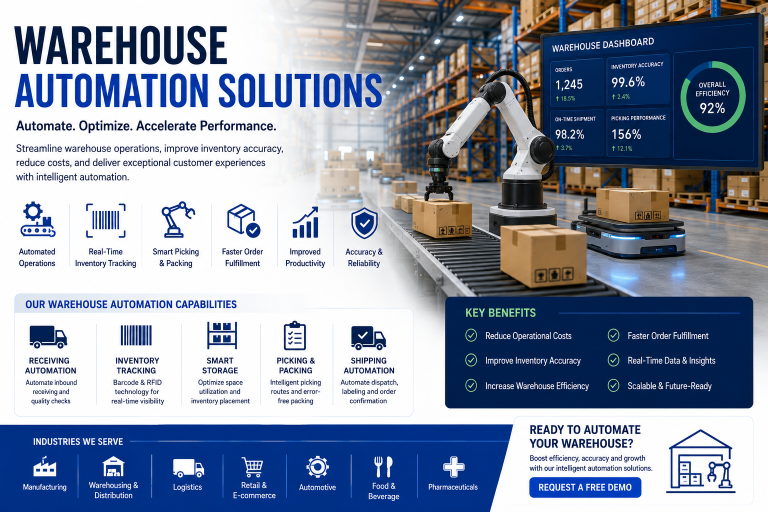
What is Warehouse Automation?
Warehouse Automation refers to the use of software, technology, and automated workflows to improve warehouse operations and reduce manual intervention.
Warehouse Automation Best Practices
The goal of warehouse automation solutions is to improve:
Inventory accuracy
Warehouse productivity
Order fulfillment speed
Inventory visibility
Operational efficiency
Resource utilization
Modern warehouse automation solutions support receiving, storage, inventory movement, picking, packing, dispatch, and inventory reporting from a centralized platform.
Inventory Management Software Dubai
Why Businesses Need Warehouse Automation
Many organizations struggle with warehouse inefficiencies that impact profitability and customer satisfaction.
Manual Inventory Processes
Manual inventory updates increase errors and consume valuable time.
Inventory Inaccuracy
Incorrect inventory records affect purchasing, production, and order fulfillment.
Slow Warehouse Operations
Manual workflows reduce warehouse productivity and increase labor costs.
Limited Visibility
Warehouse managers may lack real-time access to inventory information.
Order Fulfillment Delays
Inefficient picking and dispatch processes impact customer service levels.
Warehouse automation addresses these challenges through technology-driven workflows and real-time visibility.
warehouse management system
Key Components of Warehouse Automation
A successful warehouse automation strategy combines multiple technologies.
Inventory Management Software
Centralizes inventory control and stock visibility.
Warehouse Management System
Optimizes warehouse operations and inventory movement.
Barcode Technology
Automates inventory identification and transaction processing.
RFID Technology
Provides real-time inventory visibility and automated tracking.
Mobile Warehouse Applications
Enable warehouse staff to process inventory transactions efficiently.
Analytics and Reporting
Provide operational insights and performance monitoring.
Together, these technologies create a connected and efficient warehouse environment.
Inventory Control Software
Real-Time Inventory Visibility
Warehouse automation depends on accurate and real-time inventory information.
The system enables businesses to monitor:
Inventory quantities
Inventory locations
Warehouse stock levels
Inventory movement
Stock transfers
Order status
Organizations seeking advanced warehouse visibility often implement a warehouse management system to optimize inventory control and warehouse operations.
Benefits
Faster inventory retrieval
Better inventory accuracy
Improved operational visibility
Reduced stock discrepancies
Better decision-making
Automated Inventory Tracking
Warehouse automation eliminates many manual inventory processes.
Automated tracking supports:
Goods Receiving
Automatically record inbound inventory.
Inventory Transfers
Track stock movement between warehouse locations.
Inventory Counting
Improve inventory accuracy through automated stock verification.
Order Processing
Reduce delays and improve order fulfillment speed.
Organizations requiring advanced tracking capabilities often deploy a warehouse tracking system to improve warehouse visibility.
Barcode Warehouse Automation
Barcode technology is one of the most widely used warehouse automation tools.
Barcode automation supports:
Receiving operations
Inventory transfers
Picking processes
Inventory audits
Dispatch management
Businesses can improve operational efficiency through integrated barcode inventory management solutions.
Benefits
Reduced manual errors
Faster warehouse processing
Improved inventory visibility
Increased productivity
RFID Warehouse Automation
RFID technology enhances automation by enabling automatic inventory identification and tracking.
RFID solutions support:
Real-time inventory visibility
Inventory movement monitoring
Asset tracking
Warehouse automation
Inventory traceability
Organizations looking to increase automation and visibility can implement an RFID inventory tracking system to streamline warehouse operations.
Order Picking and Fulfillment Automation
Order fulfillment is one of the most critical warehouse activities.
Warehouse automation helps improve:
Picking Accuracy
Reduce picking errors and improve order quality.
Packing Efficiency
Improve shipment preparation and inventory verification.
Dispatch Operations
Track outbound inventory and shipment readiness.
Customer Satisfaction
Improve delivery performance through faster fulfillment.
Automated fulfillment processes improve warehouse productivity and customer service outcomes.
Factory Inventory Management Software
Warehouse Workflow Automation
Workflow automation eliminates repetitive manual tasks and improves operational consistency.
Automated workflows include:
Inventory updates
Stock movement recording
Replenishment alerts
Warehouse approvals
Inventory notifications
Exception management
Organizations seeking enterprise-wide automation can explore our business process automation solutions to optimize operational workflows.
Benefits
Lower labor costs
Faster warehouse operations
Improved consistency
Better scalability
Reduced operational risk
Manufacturing Inventory Management Software
ERP Integration
Warehouse automation should integrate seamlessly with business systems.
ERP integration supports:
Purchase orders
Inventory synchronization
Goods receipt transactions
Production updates
Dispatch confirmations
Inventory reporting
Reliable automation environments require strong infrastructure. Businesses can enhance system performance through IT infrastructure solutions UAE and secure network solutions UAE.
Warehouse Analytics and Reporting
Warehouse automation generates valuable operational data.
Analytics provide insights into:
Inventory turnover
Warehouse productivity
Fulfillment performance
Stock movement trends
Warehouse utilization
Inventory forecasting
Organizations seeking data-driven optimization can leverage predictive analytics solutions to improve planning and operational decision-making.
AI-Powered Warehouse Optimization
Artificial intelligence is transforming warehouse operations.
AI technologies support:
Inventory forecasting
Demand planning
Warehouse optimization
Inventory allocation
Operational insights
Predictive decision-making
Businesses exploring intelligent automation can learn more about our AI solutions in Dubai designed to enhance operational performance.
Cloud, Security & Data Management
Warehouse automation platforms require secure and scalable infrastructure.
The system supports:
Secure inventory records
Centralized data management
Business continuity
Multi-location visibility
Reliable system access
Organizations requiring enterprise-grade reliability can benefit from secure data storage solutions that support warehouse applications and operational systems.
Learn More Our Inventory Control SoftwareServices
Industries We Serve
Manufacturing
Automate inventory control, production inventory tracking, and warehouse operations.
Warehousing & Distribution
Improve inventory visibility and warehouse productivity.
Logistics
Track inventory movement across distribution networks.
Retail
Improve inventory accuracy and stock replenishment.
Food & Beverage
Support traceability and inventory compliance requirements.
Automotive
Manage parts inventory and warehouse operations efficiently.
Why Choose SAMCO?
SAMCO provides warehouse automation solutions designed to improve operational efficiency, inventory visibility, and warehouse performance.
Our solutions combine:
Inventory Management Software
Warehouse Management Systems
Warehouse Tracking Systems
Barcode Technology
RFID Technology
ERP Integration
Inventory Analytics
AI-Powered Insights
Organizations requiring advanced customization can also explore our custom AI development services for tailored automation solutions.
Frequently Asked Questions
What is warehouse automation?
Warehouse automation uses software and technology to automate inventory tracking, warehouse workflows, and operational processes.
How does warehouse automation improve efficiency?
Automation reduces manual work, improves inventory accuracy, and accelerates warehouse operations.
Does warehouse automation support barcode scanning?
Yes. Barcode technology is widely used for receiving, inventory transfers, picking, and dispatch activities.
Can RFID be integrated into warehouse automation?
Yes. RFID improves inventory visibility and enables automated inventory tracking.
Can warehouse automation integrate with ERP systems?
Yes. ERP integration synchronizes inventory and warehouse information across business departments.
Is warehouse automation suitable for manufacturers?
Yes. Manufacturers use warehouse automation to improve inventory control, warehouse efficiency, and production support.
Request a Free Demo
Discover how Warehouse Automation Solutions can help your organization improve inventory accuracy, warehouse productivity, order fulfillment, and operational visibility.
Contact SAMCO today to schedule a personalized demonstration and learn how intelligent warehouse automation can support your manufacturing, logistics, and warehouse operations.
Request a Free Demo
Get Pricing
Talk to an Inventory Expert


