

RFID Inventory Tracking System for Real-Time Inventory Visibility
Improve Inventory Accuracy and Warehouse Visibility with RFID Technology
RFID Inventory Tracking System, Managing inventory manually can result in stock discrepancies, inventory losses, misplaced products, and operational inefficiencies. As warehouses, manufacturing facilities, and distribution centers grow, businesses require faster and more accurate ways to track inventory movement.
An RFID Inventory Tracking System uses Radio Frequency Identification (RFID) technology to automatically identify, monitor, and track inventory throughout the supply chain. Unlike traditional barcode systems that require line-of-sight scanning, RFID technology enables automatic tracking of inventory, assets, pallets, containers, and products in real time.
Whether you operate a manufacturing facility, warehouse, logistics company, or distribution center, RFID inventory tracking provides complete visibility into inventory movement while improving operational efficiency and inventory accuracy.
Businesses seeking end-to-end inventory visibility often integrate RFID technology with inventory management software to improve stock control and warehouse operations.
Learn More Our Inventory Control SoftwareServices
What is an RFID Inventory Tracking System?
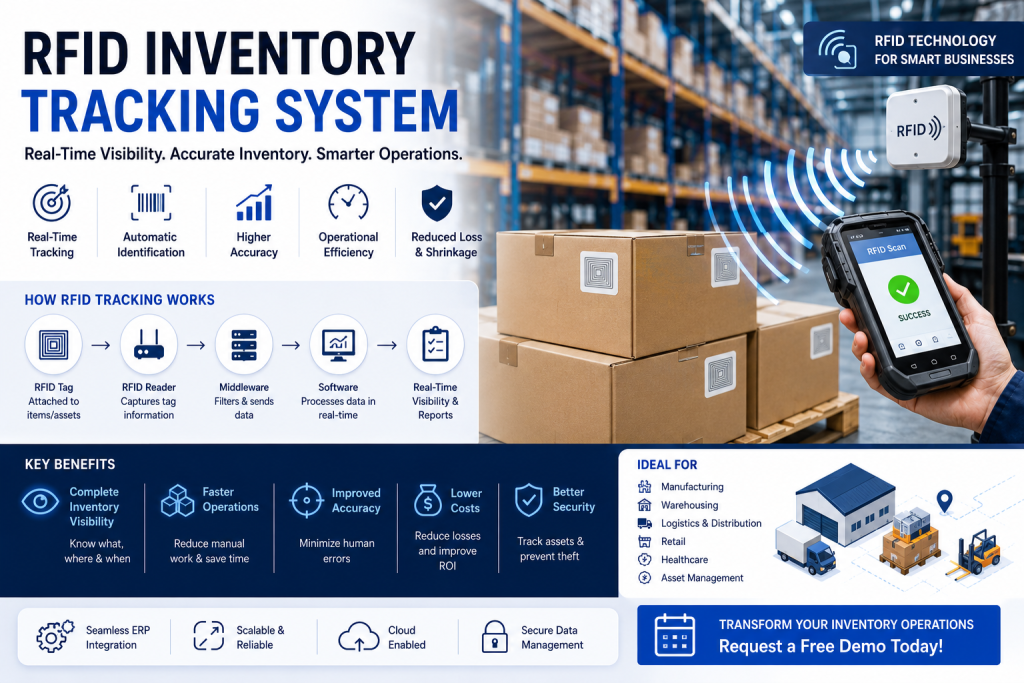
An RFID Inventory Tracking System is a technology-driven solution that uses RFID tags, RFID readers, antennas, and inventory software to track inventory automatically.
RFID Technology and Asset Tracking
Each inventory item is assigned an RFID tag containing unique identification data. RFID readers detect these tags and automatically update inventory records without manual intervention.
Core Components
RFID Tags
RFID Readers
RFID Antennas
RFID Middleware
Inventory Management Software
Warehouse Management System
Organizations implementing RFID solutions gain real-time inventory visibility and improved inventory traceability.
For additional information about RFID technology, explore RFID Inventory Tracking Technology.
Inventory Management Software Dubai
Why Businesses Need RFID Inventory Tracking
Traditional inventory tracking methods often create operational challenges.
Manual Inventory Counts
Inventory audits consume valuable time and resources.
Inventory Inaccuracy
Manual updates increase the risk of stock discrepancies.
Lost Inventory
Products may be misplaced without accurate location tracking.
Limited Visibility
Businesses often struggle to monitor inventory movement across warehouses.
Delayed Inventory Updates
Inventory records may not reflect real-time stock availability.
An RFID Inventory Tracking System solves these challenges through automated inventory tracking and real-time visibility.
warehouse management system
How RFID Inventory Tracking Works
The RFID process is simple and highly effective.
Step 1: RFID Tag Assignment
RFID tags are attached to inventory items, pallets, containers, or assets.
Step 2: Inventory Detection
RFID readers automatically identify tagged items within their detection range.
Step 3: Data Collection
Inventory information is collected and transmitted to the software platform.
Step 4: Real-Time Updates
Inventory records are updated automatically without manual data entry.
Step 5: Inventory Visibility
Warehouse teams gain instant visibility into inventory location and movement.
This process significantly improves inventory accuracy while reducing labor-intensive tasks.
Inventory Control Software
Real-Time Inventory Visibility
One of the most significant advantages of RFID technology is real-time visibility.
Businesses can instantly view:
Inventory quantities
Inventory locations
Inventory movement history
Warehouse stock levels
Asset locations
Inventory status
Organizations seeking complete warehouse visibility often combine RFID technology with a warehouse management system to improve warehouse efficiency and operational control.
Benefits
Faster inventory searches
Improved stock accuracy
Better inventory planning
Reduced inventory losses
Enhanced operational visibility
Warehouse Management System
RFID Warehouse Management
RFID technology transforms warehouse operations by automating inventory tracking processes.
Warehouse applications include:
Goods Receiving
Automatically identify incoming inventory.
Warehouse Storage
Track inventory locations across racks, shelves, and bins.
Inventory Transfers
Monitor inventory movement between warehouse locations.
Order Picking
Improve picking accuracy and reduce fulfillment errors.
Dispatch Operations
Track outbound inventory and shipment preparation.
Businesses requiring advanced warehouse visibility often implement a warehouse tracking system alongside RFID technology.
Warehouse Tracking System
RFID Asset Tracking
Many organizations use RFID technology for asset management.
RFID asset tracking supports:
Equipment tracking
Tool tracking
Asset location monitoring
Asset utilization reporting
Maintenance visibility
Real-time asset visibility improves accountability while reducing asset losses.
Barcode Inventory Management
RFID vs Barcode Inventory Tracking
Both RFID and barcode technologies help improve inventory accuracy, but RFID offers additional automation capabilities.
Barcode Tracking
Requires manual scanning
Lower implementation cost
Suitable for smaller operations
RFID Tracking
Automatic identification
Faster inventory processing
Real-time inventory visibility
Improved scalability
Many organizations use both technologies together to optimize warehouse and inventory management operations.
Manufacturing Inventory Management Software
Manufacturing Inventory Management with RFID
Manufacturers require accurate inventory tracking throughout production processes.
RFID technology supports:
Raw Material Tracking
Monitor inventory used in production activities.
Work-in-Progress Tracking
Track materials and components moving through production stages.
Finished Goods Tracking
Monitor completed products through storage and distribution.
Production Visibility
Provide real-time inventory information to production teams.
RFID helps manufacturers improve production efficiency while reducing inventory-related disruptions.
Warehouse Automation
RFID is a key component of warehouse automation initiatives.
Automated workflows include:
Inventory updates
Inventory counting
Warehouse transactions
Asset monitoring
Inventory movement tracking
Stock visibility
Organizations seeking broader automation capabilities can explore our business process automation solutions to streamline warehouse and inventory processes.
Benefits
Reduced labor costs
Faster warehouse operations
Improved inventory accuracy
Better scalability
Increased operational efficiency
Warehouse Automation Solutions
ERP Integration
RFID systems become significantly more powerful when integrated with ERP platforms.
Integration supports:
Inventory synchronization
Purchase order updates
Goods receipt transactions
Production updates
Asset management
Inventory reporting
Reliable RFID deployments depend on strong infrastructure. Businesses can enhance operational performance through our IT infrastructure solutions UAE and secure network solutions UAE.
Factory Inventory Management Software
RFID Analytics and Reporting
RFID technology generates valuable operational data.
Analytics provide insights into:
Inventory utilization
Asset utilization
Inventory turnover
Stock movement trends
Warehouse productivity
Inventory forecasting
Organizations looking to improve forecasting accuracy can leverage predictive analytics solutions to make more informed inventory decisions.
Cloud, Security & Data Management
Modern RFID environments require secure and scalable technology infrastructure.
The system supports:
Secure inventory records
Centralized data management
Real-time inventory access
Business continuity
Multi-location visibility
Organizations requiring enterprise-grade infrastructure can benefit from reliable data storage solutions that support inventory and warehouse applications.
predictive analytics solutions
Industries We Serve
Manufacturing
Track raw materials, production inventory, and finished goods.
Warehousing & Distribution
Improve warehouse visibility and inventory accuracy.
Logistics
Track inventory movement across distribution networks.
Retail
Monitor inventory availability and stock replenishment.
Healthcare
Track medical equipment, supplies, and inventory assets.
Automotive
Manage parts inventory and production components.
Why Choose SAMCO?
SAMCO delivers RFID inventory tracking solutions designed to improve visibility, automation, and inventory accuracy.
Our RFID solutions include:
RFID inventory tracking
RFID warehouse management
Asset tracking
Inventory visibility
ERP integration
Inventory analytics
Warehouse automation
Multi-location support
Businesses requiring advanced customization and intelligent automation can also explore our custom AI development services for tailored operational solutions.
Learn More Our Inventory Control SoftwareServices
Frequently Asked Questions
What is RFID inventory tracking?
RFID inventory tracking uses radio frequency technology to identify and track inventory automatically.
How does RFID improve inventory accuracy?
RFID reduces manual data entry and automatically updates inventory records in real time.
Can RFID track warehouse inventory?
Yes. RFID is widely used for warehouse inventory management, inventory visibility, and warehouse automation.
Can RFID integrate with ERP systems?
Yes. RFID systems can synchronize inventory information with ERP platforms.
Is RFID suitable for manufacturing businesses?
Yes. Manufacturers use RFID to track raw materials, work-in-progress inventory, and finished goods.
What is the difference between RFID and barcode tracking?
Barcode systems require manual scanning, while RFID automatically identifies and tracks inventory.
Request a Free Demo
Discover how an RFID Inventory Tracking System can help your organization improve inventory accuracy, automate warehouse operations, and gain real-time inventory visibility.
Contact SAMCO today to schedule a personalized demonstration and learn how RFID technology can support your warehouse, manufacturing, and supply chain operations
Inventory Control Software
Request a Free Demo
Get Pricing
Talk to an Inventory Expert


