

Barcode Inventory Management: Benefits, Features & Business Guide (2026)
Inventory accuracy directly affects purchasing, warehouse operations, order fulfillment, and customer satisfaction. When stock information is inaccurate, businesses face unnecessary purchases, delayed deliveries, and products that cannot be located when customers need them. These problems often become more frequent as inventory grows and manual tracking methods become difficult to manage.
A barcode inventory management system gives every product a unique identity. By scanning a barcode during receiving, storage, stock transfers, and dispatch, inventory records are updated instantly. This reduces manual entry, improves stock accuracy, and gives employees reliable information while carrying out daily operations.
Barcode technology is now used across retail, wholesale, manufacturing, healthcare, logistics, and warehouse operations because it is practical, affordable, and easy to scale. It helps businesses process inventory faster, reduce operational errors, and maintain accurate stock records without adding unnecessary complexity.
For businesses looking to improve inventory control across multiple locations, barcode technology delivers the greatest value when integrated with Inventory Management Software Dubai.
Businesses managing larger warehouses can also combine barcode technology with a Warehouse Management System to improve receiving, put-away, picking, packing, and dispatch operations.
Companies planning warehouse automation or high-volume inventory tracking may later expand their solution with an RFID Inventory Tracking System as operational requirements grow.
Understanding how barcode inventory management works—and selecting software that supports your business processes—helps improve inventory accuracy, warehouse efficiency, and long-term operational performance.
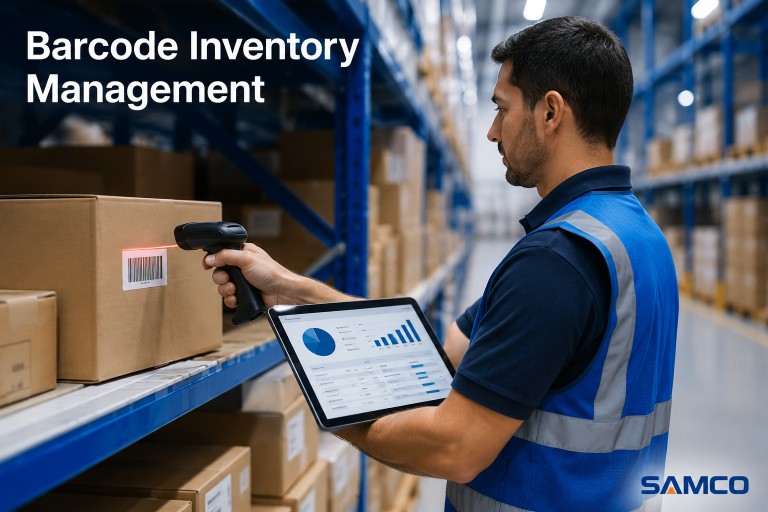
What Is Barcode Inventory Management?
Barcode inventory management is a method of tracking products using unique barcode labels. Each barcode represents a specific product and can be scanned during receiving, storage, stock transfers, sales, and dispatch. Every scan automatically updates inventory records, helping businesses maintain accurate stock information without relying on manual data entry.
Unlike spreadsheets or handwritten inventory logs, barcode systems provide consistent and reliable inventory updates throughout daily operations. Employees can quickly identify products, verify stock quantities, and complete inventory transactions with fewer errors. This not only improves productivity but also reduces the time spent searching for products or correcting inventory discrepancies. GS1 Barcode Standards
Barcode technology is widely used across retail, wholesale, manufacturing, logistics, and healthcare because it is affordable, easy to implement, and scalable. As inventory volumes grow, barcode systems continue to support faster stock movement while improving inventory accuracy and operational efficiency.
For businesses looking to centralize inventory across multiple warehouses or business locations, barcode technology delivers even greater value when integrated with Inventory Management Software Dubai. Larger warehouse operations can also combine barcode scanning with a Warehouse Management System to improve receiving, put-away, picking, packing, and shipping processes. Businesses planning long-term warehouse automation may eventually adopt an RFID Inventory Tracking System for automated inventory identification without manual scanning.
How Does Barcode Inventory Management Work?
A barcode inventory management system works by assigning a unique barcode to every product stored in your inventory. Each barcode contains product information that can be quickly retrieved using a barcode scanner, mobile device, or handheld terminal. Every time an item is received, transferred, picked, sold, or dispatched, the barcode is scanned, and the inventory record is updated instantly.
The process usually begins when new inventory arrives at the warehouse. Products are labelled with barcode stickers if they do not already have manufacturer barcodes. During receiving, warehouse staff scan each item to record quantities, verify purchase orders, and update stock levels. This eliminates manual data entry and reduces receiving errors.
As products move through the warehouse, barcode scanning continues to support daily operations. Employees scan items during storage, internal transfers, picking, packing, and shipping, ensuring inventory records always reflect the actual stock available. This real-time visibility helps businesses avoid stock shortages, duplicate purchases, and inventory discrepancies.
Barcode systems become even more powerful when integrated with Inventory Management Software Dubai. Instead of recording transactions separately, inventory updates automatically synchronize with purchasing, sales, and reporting, giving every department access to accurate stock information.
For businesses operating larger warehouses, integrating barcode scanning with a Warehouse Tracking System makes it easier to locate products, monitor inventory movement, and improve order fulfillment accuracy. Companies planning future warehouse automation can also upgrade to an RFID Inventory Tracking System without replacing their existing inventory software.
By automating routine inventory transactions, barcode technology helps businesses improve productivity, reduce operational errors, and maintain reliable inventory records that support better purchasing and warehouse decisions.
Benefits of Barcode Inventory Management for Businesses
Investing in a barcode inventory management system is more than replacing manual stock records. It creates a structured inventory process that improves accuracy, speeds up warehouse operations, and provides better visibility into inventory movement. Businesses that rely on fast order processing and accurate stock information often see measurable improvements after implementing barcode technology.
Improve Inventory Accuracy
Manual inventory updates increase the risk of incorrect stock quantities, duplicate records, and misplaced products. Barcode scanning records inventory movements instantly, ensuring stock information remains accurate throughout receiving, storage, transfers, and dispatch. This helps businesses make purchasing decisions based on reliable inventory data instead of estimates.
Reduce Manual Work
Entering product information manually takes time and increases the possibility of human error. Barcode scanning allows employees to complete inventory transactions with a quick scan, improving productivity while reducing repetitive administrative tasks.
Speed Up Warehouse Operations
Warehouse teams process hundreds or even thousands of inventory movements every day. Barcode scanning makes receiving, put-away, picking, packing, and shipping faster because product information is captured instantly. When combined with a Warehouse Management System, businesses can further improve warehouse efficiency by optimizing storage locations and order fulfillment workflows.
Better Inventory Visibility
Knowing where products are stored and how much inventory is available helps businesses avoid stock shortages and unnecessary purchases. Integrating barcode technology with Inventory Management Software Dubai provides real-time inventory visibility across warehouses, retail stores, and distribution centres, allowing managers to make faster operational decisions.
Lower Operational Costs
Inventory inaccuracies often lead to emergency purchases, excess stock, customer complaints, and wasted warehouse space. Accurate barcode tracking helps businesses reduce these unnecessary costs while improving overall inventory control.
Easy to Scale as Your Business Grows
Barcode technology supports businesses of every size. As inventory volumes increase, additional products, warehouses, and users can be managed without changing the entire inventory process. Businesses planning future automation can also expand to an RFID Inventory Tracking System while continuing to use their existing inventory management platform.
By improving inventory accuracy, increasing operational efficiency, and reducing manual work, barcode inventory management provides a practical foundation for businesses looking to build a more reliable and scalable inventory operation.
Barcode Inventory Management vs Manual Inventory Management
Many small businesses begin by managing inventory with spreadsheets, paper records, or manual stock counts. While these methods may work with a limited number of products, they become difficult to manage as inventory grows. Manual processes often lead to stock discrepancies, delayed updates, duplicate entries, and time-consuming inventory audits.
A barcode inventory management system replaces these repetitive tasks with a faster and more reliable process. Every product movement is recorded through barcode scanning, ensuring inventory information is updated immediately. This reduces the risk of human error while giving employees accurate stock information throughout daily operations.
The difference becomes even more noticeable in busy warehouse environments. Warehouse staff no longer need to search through spreadsheets or manually verify inventory records. Instead, products can be identified, counted, and located within seconds, improving both inventory accuracy and order fulfillment speed.
| Manual Inventory Management | Barcode Inventory Management |
|---|---|
| Manual data entry | Instant barcode scanning |
| Higher risk of inventory errors | Accurate inventory updates |
| Time-consuming stock counts | Faster inventory verification |
| Limited inventory visibility | Real-time stock information |
| Difficult to manage multiple locations | Centralized inventory tracking |
| Slower order processing | Faster receiving, picking, and dispatch |
As inventory volume increases, businesses also need greater control over warehouse operations. Integrating barcode technology with a Warehouse Tracking System allows teams to monitor product movement more efficiently, while Inventory Management Software Dubai centralizes inventory, purchasing, sales, and reporting into a single platform.
For businesses planning long-term warehouse automation, barcode technology also provides a practical foundation for adopting an RFID Inventory Tracking System in the future without completely changing existing inventory processes.
Moving from manual inventory management to barcode technology is not simply about replacing paperwork—it is about creating a more accurate, efficient, and scalable inventory operation that supports business growth.
Essential Features to Look for in a Barcode Inventory Management System
Not every barcode inventory management system offers the same capabilities. Choosing software based only on price or basic barcode scanning can create operational challenges as your business grows. The right solution should improve inventory accuracy, simplify warehouse operations, and integrate with your existing business processes.
Before selecting a barcode inventory system, evaluate whether it includes the following essential features.
Real-Time Inventory Updates
Every barcode scan should immediately update inventory records. Real-time visibility helps businesses maintain accurate stock levels, prevent stock shortages, and make informed purchasing decisions without waiting for manual inventory reports.
Multi-Warehouse Inventory Management
Businesses operating multiple warehouses or branches need centralized inventory visibility. The system should allow inventory transfers between locations while maintaining accurate stock records across every warehouse.
Fast Barcode Scanning
The software should support handheld scanners, mobile devices, and wireless barcode readers. Fast scanning reduces receiving, picking, and dispatch times while improving employee productivity.
Inventory Search and Product Traceability
Employees should be able to locate products quickly using barcode numbers, product names, or SKU codes. Faster product identification reduces warehouse delays and improves order fulfillment.
Reporting and Inventory Analytics
A good barcode inventory system should provide reports on stock movement, inventory valuation, fast-moving products, slow-moving inventory, stock ageing, and reorder levels. These reports help businesses make better purchasing and inventory planning decisions.
Integration with Business Systems
Inventory data should not exist in isolation. A barcode system should integrate with Inventory Management Software Dubai to synchronize purchasing, sales, inventory, and reporting. Businesses with larger warehouse operations should also consider integration with a Warehouse Management System to improve inventory movement throughout the warehouse.
Future Automation Support
As operations expand, businesses may require higher levels of automation. Choosing software that supports an RFID Inventory Tracking System ensures future upgrades can be implemented without replacing the entire inventory management platform.
Selecting software with these capabilities helps businesses build an inventory management process that remains efficient, scalable, and reliable as operational requirements continue to grow.
Barcode Inventory Management vs RFID Inventory Tracking: Which Solution Is Right for Your Business?
Barcode and RFID are two proven technologies for improving inventory accuracy, but they solve different operational challenges. The right choice depends on your inventory volume, warehouse processes, automation goals, and budget.
A Barcode Inventory Management system identifies products by scanning printed barcode labels. Each product must be scanned individually using a barcode scanner or mobile device. This approach is affordable, easy to implement, and suitable for most businesses that want to replace manual inventory tracking with a faster and more accurate process.
An RFID Inventory Tracking System uses radio frequency tags instead of printed barcodes. RFID readers automatically detect tagged products without direct line-of-sight scanning, making it possible to identify multiple items simultaneously. This significantly reduces manual work and improves inventory visibility in large warehouse environments.
| Barcode Inventory Management | RFID Inventory Tracking |
|---|---|
| Lower implementation cost | Higher initial investment |
| Requires barcode scanning | Automatic tag detection |
| One item scanned at a time | Multiple items detected simultaneously |
| Suitable for most businesses | Suitable for high-volume warehouse operations |
| Quick implementation | More advanced infrastructure required |
| Easy employee training | Best for large-scale automation |
For many businesses, barcode technology provides everything needed to improve inventory control, reduce manual errors, and speed up warehouse operations. Retail stores, wholesalers, distributors, healthcare providers, and small to medium-sized warehouses often achieve excellent results using barcode systems.
Businesses managing high-value assets, large distribution centres, or thousands of daily inventory movements may benefit from an RFID Inventory Tracking System, especially when real-time inventory visibility and warehouse automation become business priorities.
Before selecting either technology, evaluate your current inventory processes, future growth plans, and operational requirements. The right technology should support your business for years—not just solve today’s challenges.
Industries That Benefit from Barcode Inventory Management
Barcode inventory management is used across many industries because it provides a simple and reliable way to track inventory throughout daily operations. While every business has different inventory requirements, the goal is the same—maintain accurate stock records, reduce manual work, and improve operational efficiency.
Retail
Retail businesses manage large product catalogues, seasonal inventory, and daily sales transactions. Barcode scanning keeps inventory records up to date after every sale, return, or stock replenishment. This reduces stock discrepancies, improves shelf availability, and helps staff serve customers more efficiently.
Wholesale & Distribution
Wholesale businesses process large quantities of inventory every day. Barcode scanning speeds up receiving, stock transfers, order picking, and dispatch while reducing shipping errors. When integrated with a Warehouse Tracking System, businesses gain better visibility into product movement across warehouses and distribution centres.
Manufacturing
Manufacturers must track raw materials, work-in-progress inventory, and finished goods throughout production. Barcode technology provides accurate inventory records at every production stage, reducing material shortages and improving production planning.
Businesses looking for advanced production inventory control should consider Manufacturing Inventory Management Software, which helps monitor inventory consumption, production orders, and finished goods more effectively.
Factory Operations
Factories often manage thousands of components, spare parts, packaging materials, and finished products. Barcode scanning improves inventory accuracy while reducing production delays caused by missing or misplaced materials.
A dedicated Factory Inventory Management Softwaresolution further supports production planning, warehouse coordination, and inventory replenishment for factory environments.
Healthcare & Pharmaceuticals
Hospitals, clinics, and pharmaceutical companies rely on accurate inventory records to manage medicines, medical devices, and consumables. Barcode scanning helps staff quickly identify products, monitor inventory availability, and reduce dispensing errors while supporting better stock control.
Logistics & Warehousing
Warehouse operations depend on fast inventory movement and accurate order fulfilment. Barcode scanning improves receiving, storage, picking, packing, and shipping by ensuring every inventory transaction is recorded immediately. Combined with Inventory Management Software Dubai, businesses gain complete visibility into inventory across multiple warehouse locations.
Why Barcode Technology Works Across Industries
Regardless of the industry, businesses share similar inventory challenges—manual data entry, inaccurate stock records, delayed inventory updates, and inefficient warehouse processes. Barcode inventory management addresses these challenges by creating a faster, more reliable, and scalable inventory process that supports business growth.
How to Choose the Right Barcode Inventory Management System
Choosing a barcode inventory management system is not simply about selecting software with the longest feature list. The right solution should match your daily operations, improve inventory accuracy, and continue supporting your business as it grows. Before making a decision, evaluate how well the system fits your current processes and future requirements.
Understand Your Inventory Workflow
Start by reviewing how inventory moves through your business. Consider how products are received, stored, transferred, picked, packed, and dispatched. A barcode system should simplify these activities instead of creating additional work for your team.
Choose Software That Grows with Your Business
Inventory requirements change as businesses expand. Select a solution that supports additional products, warehouse locations, users, and higher transaction volumes without requiring a complete software replacement. Scalability protects your investment and reduces future implementation costs.
Check Integration Capabilities
Your barcode system should connect with purchasing, sales, accounting, and reporting. Businesses that use Inventory Management Software Dubai can synchronize inventory updates automatically, giving every department access to the same accurate information without duplicate data entry.
Evaluate Warehouse Features
If your business operates one or more warehouses, look for features that improve receiving, storage, picking, packing, and shipping. Integrating barcode technology with a Warehouse Management System helps organize warehouse operations, while a Warehouse Tracking System makes it easier to locate products and monitor inventory movement in real time.
Ensure Hardware Compatibility
Before selecting a system, confirm that it supports the barcode scanners, mobile devices, label printers, and handheld terminals your business uses or plans to purchase. Hardware compatibility reduces implementation challenges and keeps warehouse operations running efficiently.
Review Reporting and Support
Inventory reports should provide useful information, including stock levels, inventory movement, reorder points, and product performance. Also evaluate the vendor’s implementation process, training, and ongoing technical support. Reliable support helps employees adopt the system faster and reduces operational disruptions.
Choosing the right barcode inventory management system is a long-term business decision. Software that fits your workflows, integrates with existing systems, and supports future growth will deliver greater operational value than a solution chosen only because of its price or feature list.
Why Businesses Choose SAMCO for Barcode Inventory Management
Implementing a barcode inventory management system involves more than installing software. A successful deployment requires understanding inventory workflows, warehouse operations, and the day-to-day challenges employees face while receiving, storing, picking, and dispatching products. Choosing the right implementation partner helps businesses achieve better results with fewer operational disruptions.
At SAMCO, every barcode inventory solution is planned around the way your business operates. Before implementation, we evaluate your inventory process, warehouse layout, product movement, and reporting requirements to recommend a solution that supports your current operations while allowing room for future growth.
Our barcode inventory solutions integrate with Inventory Management Software Dubai, helping businesses manage purchasing, inventory, sales, and reporting from a single platform. For organizations with larger warehouse operations, we also implement Warehouse Management System solutions that improve receiving, storage, picking, packing, and dispatch. Businesses planning warehouse automation can further expand with an RFID Inventory Tracking Systemwhen operational requirements evolve.
Beyond implementation, we support businesses with system configuration, barcode label design, hardware integration, user training, data migration, and ongoing technical support. This helps employees adopt the system confidently while reducing implementation delays and improving operational efficiency.
Whether your goal is to replace manual inventory records, improve warehouse accuracy, or prepare for business expansion, our approach focuses on delivering a practical solution that fits your operations rather than recommending unnecessary features.
Frequently Asked Questions About Barcode Inventory Management
1. What is Barcode Inventory Management?
Barcode inventory management is a system that uses barcode labels and scanners to identify, track, and manage inventory throughout receiving, storage, stock transfers, sales, and dispatch. Every barcode scan updates inventory records automatically, helping businesses maintain accurate stock information while reducing manual data entry.
2. What are the benefits of Barcode Inventory Management?
Barcode inventory management helps businesses improve inventory accuracy, reduce manual errors, speed up warehouse operations, simplify stock audits, and maintain real-time inventory visibility. It also improves purchasing decisions by providing reliable inventory data.
3. Which businesses should use Barcode Inventory Management?
Barcode inventory management is suitable for businesses that regularly store, move, or sell inventory, including:
Retail stores
Wholesale distributors
Manufacturing companies
Warehouses
Logistics providers
Healthcare organizations
Food and beverage businesses
4. Can Barcode Inventory Management support multiple warehouses?
Yes. Most modern barcode inventory systems allow businesses to manage inventory across multiple warehouses or branches while maintaining centralized inventory visibility.
For businesses managing complex warehouse operations, integrating with a Warehouse Management System provides additional control over receiving, storage, picking, and dispatch.
5. Is Barcode better than manual inventory management?
For most businesses, yes. Barcode scanning is faster, more accurate, and significantly reduces human error compared to spreadsheets or manual stock records. It also provides real-time inventory updates, making daily inventory management much more efficient.
6. What is the difference between Barcode and RFID?
Barcode technology requires each item to be scanned individually, while RFID uses radio-frequency tags that can automatically identify multiple items without direct scanning. Barcode is often the preferred choice for businesses looking for an affordable inventory tracking solution, while RFID is commonly used in larger automated warehouse environments.
7. Can Barcode Inventory Management integrate with inventory software?
Yes. Barcode technology delivers the best results when integrated with Inventory Management Software Dubai, allowing inventory updates to synchronize automatically with purchasing, sales, inventory control, and reporting.
8. What equipment is required for a Barcode Inventory Management System?
Most businesses require:
Barcode labels
Barcode scanners
Label printers
Mobile computers or handheld terminals
Barcode inventory management software
The required hardware depends on inventory volume and operational requirements.
9. How long does Barcode Inventory Management implementation take?
Implementation time depends on inventory size, warehouse complexity, system integrations, and data preparation. Small businesses may complete implementation within a few days, while larger organizations with multiple warehouses may require several weeks for configuration, testing, and employee training.
10. How do I choose the right Barcode Inventory Management solution?
Choose a solution that matches your inventory processes, supports business growth, integrates with existing systems, and provides reliable implementation and technical support. Evaluating scalability, reporting, barcode hardware compatibility, and warehouse functionality helps ensure a successful long-term investment.
Conclusion
Barcode inventory management provides a practical way to improve inventory accuracy, reduce manual work, and simplify warehouse operations. By replacing paper-based records and spreadsheets with barcode scanning, businesses gain real-time visibility into inventory, improve order accuracy, and make better purchasing decisions using reliable stock information.
The right barcode inventory management system should fit your daily operations, support future business growth, and integrate with your existing software. Features such as real-time inventory updates, multi-warehouse management, reporting, and seamless integration with warehouse processes help create a more efficient and scalable inventory operation.
For businesses planning long-term growth, selecting the right technology today reduces operational challenges in the future. Whether you manage a retail store, warehouse, manufacturing facility, or distribution centre, barcode inventory management creates a strong foundation for better inventory control and operational efficiency.
If you’re planning to modernize your inventory processes, explore our Barcode Inventory Management solution to see how barcode technology can help improve stock accuracy, streamline warehouse operations, and support business growth.
Explore our Barcode Inventory Management solution to see how barcode technology can help improve stock accuracy, streamline warehouse operations, and support business growth.
Businesses looking for a complete inventory solution can also explore our Inventory Management Software Dubai platform for centralized inventory control, purchasing, reporting, and warehouse management.


