


UAE Tax Invoice Format: Complete VAT-Compliant Guide for UAE Businesses
Understanding the UAE tax invoice format is essential for every VAT-registered business operating in the United Arab Emirates. A compliant tax invoice format UAE businesses use must include specific information required by the Federal Tax Authority (FTA), helping organizations maintain VAT compliance, support tax reporting, and avoid costly penalties. Whether you are looking for a VAT invoice format UAE, a sample invoice template, or guidance on the latest invoicing requirements, this guide explains everything you need to know about creating a compliant UAE VAT invoice format for your business.
What Is Tax Invoice in UAE?
Many business owners ask, what is tax invoice in UAE and why it is important. A tax invoice is an official document issued by a VAT-registered supplier that records the sale of goods or services and shows the applicable VAT amount. The tax invoice meaning goes beyond simple billing; it serves as a legal tax document required for VAT reporting and input tax recovery.
The tax invoice definition under UAE VAT regulations requires businesses to provide accurate transaction details, VAT information, and supplier identification. A properly prepared tax invoice UAE businesses issue helps ensure compliance and financial transparency.
Why Is a Tax Invoice Important for UAE Businesses?
A VAT-compliant tax invoice uae provides significant benefits beyond regulatory compliance.
VAT Compliance
The Federal Tax Authority requires VAT-registered businesses to issue invoices containing specific information. Non-compliant invoices may lead to penalties and tax reporting issues.
Accurate Financial Reporting
Tax invoices help organizations maintain accurate revenue records, tax calculations, and accounting documentation.
Audit Readiness
During FTA audits, businesses must demonstrate proper documentation for taxable supplies. Tax invoices play a critical role in proving compliance.
Input VAT Recovery
Businesses claiming VAT on purchases must possess valid tax invoices that contain all mandatory information.
UAE VAT Invoice Template Solutions
Improved Cash Flow Management
Professional invoicing practices reduce disputes, accelerate approvals, and improve payment collection cycles.
Digital Transformation Readiness
Modern tax invoice systems support automation, ERP integration, and future e-invoicing requirements.
VAT-Compliant Invoice Templates UAE
ERP E-Invoice Integration Services
UAE Tax Invoice Format Requirements
A UAE tax invoice must include specific information to comply with VAT regulations.
The required information depends on whether the invoice is a Standard Tax Invoice or Simplified Tax Invoice.
The following information is generally required:
Supplier Information
The invoice must clearly display:
Business name
Business address
Contact details
Tax Registration Number (TRN)
The supplier’s Tax Registration Number must be included on the invoice.
The TRN identifies the business as a VAT-registered entity.
Invoice Number
Each invoice must have a unique sequential invoice number.
The invoice numbering system should support:
Traceability
Audit requirements
Financial recordkeeping
Example:
INV-2026-001
Invoice Issue Date
The tax invoice must include the date the invoice was issued.
Customer Information
For standard tax invoices, customer details may include:
Company name
Address
TRN (where applicable)
Description of Goods or Services
The invoice should clearly describe:
Products supplied
Services provided
Project references if applicable
Quantity
Where applicable, quantities must be specified.
Unit Price
The invoice should indicate pricing before VAT.
VAT Rate
The applicable VAT percentage should be displayed.
VAT Amount
The exact VAT amount must be shown separately.
Total Invoice Value
The invoice should indicate:
Net amount
VAT amount
Gross total
Currency
The invoice must specify the transaction currency.
Mandatory Fields in UAE Tax Invoice
The table below summarizes the essential components of a VAT-compliant invoice.
| Mandatory Field | Required |
|---|---|
| Supplier Name | Yes |
| Supplier Address | Yes |
| Tax Registration Number (TRN) | Yes |
| Invoice Number | Yes |
| Invoice Date | Yes |
| Customer Name | Yes |
| Customer Address | Yes |
| Goods or Service Description | Yes |
| Quantity | Yes |
| Unit Price | Yes |
| VAT Rate | Yes |
| VAT Amount | Yes |
| Total Amount | Yes |
| Currency | Yes |
Businesses should regularly review their invoice templates to ensure all mandatory fields are present.
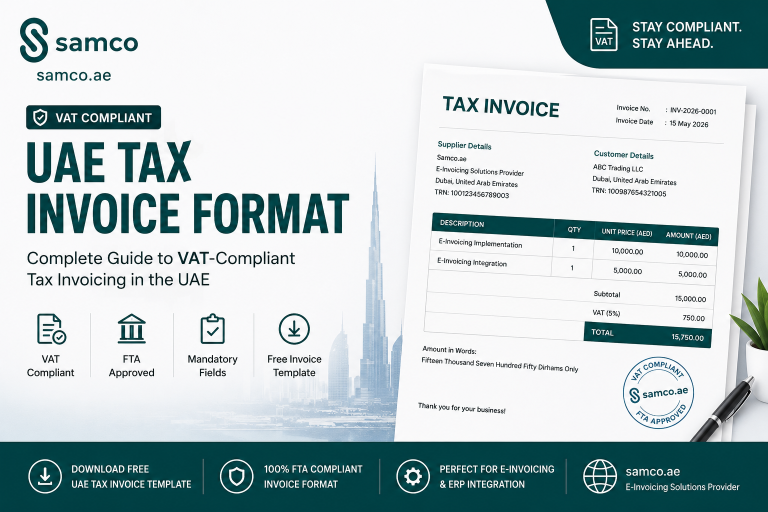
VAT Invoice Format UAE Example
Below is a simplified example of a VAT-compliant invoice, VAT Invoice Format in UAE Example
.
| Field | Example |
|---|---|
| Invoice Number | INV-2026-001 |
| Invoice Date | 15 June 2026 |
| Supplier | ABC Trading LLC |
| TRN | 100123456789012 |
| Customer | XYZ Industries LLC |
| Description | ERP Implementation Services |
| Amount | AED 10,000 |
| VAT 5% | AED 500 |
| Total | AED 10,500 |
This example illustrates the minimum information businesses should include when issuing tax invoices.
Standard Tax Invoice vs Simplified Tax Invoice
The UAE VAT framework recognizes two primary invoice types.
Standard Tax Invoice
A standard tax invoice contains detailed information regarding both supplier and customer.
Typically used for:
Business-to-business transactions
Corporate customers
High-value transactions
VAT recovery purposes
A standard tax invoice generally includes:
Supplier details
Customer details
TRN information
VAT breakdown
Simplified Tax Invoice
A simplified tax invoice contains fewer details and is commonly used in retail and consumer transactions.
Typical use cases include:
Retail sales
Small transactions
Walk-in customers
Simplified invoices generally include:
Supplier information
Invoice date
Description
VAT amount
Total amount
Businesses should determine which invoice format is appropriate based on transaction type and FTA requirements.
FTA Tax Invoice Format Requirements
The Federal Tax Authority requires businesses to maintain proper documentation for all taxable transactions.
Key FTA tax invoice requirements include:
Federal Tax Authority (FTA) UAE
Accurate VAT Calculation
VAT must be calculated correctly and displayed separately.
Clear Transaction Details
Descriptions should accurately reflect goods supplied or services rendered.
Proper Invoice Numbering
Each invoice should have a unique identifier.
Retention of Records
Businesses must maintain invoices and supporting records according to UAE regulatory requirements.
Audit Accessibility
Invoices should be stored in a format that supports inspection and audit processes.
Common UAE Tax Invoice Mistakes
Many businesses unintentionally create compliance risks through invoice errors.
Missing TRN
Failure to include the Tax Registration Number is one of the most common compliance issues.
Incorrect VAT Calculation
Calculation errors can result in underpayment or overpayment of VAT.
Duplicate Invoice Numbers
Duplicate numbering creates audit and accounting complications.
Missing Customer Information
Incomplete customer details may affect VAT recovery eligibility.
Incorrect Invoice Dates
Invoice dates play an important role in VAT reporting periods.
Missing VAT Breakdown
VAT should be clearly identified and separated from the net invoice value.
Inconsistent Templates
Using multiple invoice formats increases compliance risks.
Best Practices for Creating VAT-Compliant Tax Invoices
Organizations should implement consistent invoice management procedures.
Use Standardized Templates
Standardized invoice formats reduce errors and improve compliance.
Automate Invoice Generation
Automated invoicing systems improve accuracy and efficiency.
Maintain Sequential Invoice Numbers
A structured numbering system supports audits and reporting.
Validate Data Before Issuance
Verify:
Customer details
VAT calculations
TRN information
Invoice values
Archive Invoices Securely
Digital storage improves accessibility and compliance.
UAE E-Invoicing and Tax Invoice Compliance
The UAE is moving toward a more digitally connected tax environment.
As governments worldwide adopt electronic invoicing frameworks, businesses should prepare by modernizing invoicing processes and implementing compliant systems.
E-invoicing allows organizations to:
Generate invoices electronically
Exchange invoice data securely
Improve compliance controls
Automate validation processes
Reduce manual errors
Increase operational efficiency
Businesses that invest in digital invoicing capabilities today will be better positioned for future regulatory requirements.
Organizations should evaluate:
ERP integration capabilities
Invoice automation solutions
Compliance readiness
Reporting systems
Data validation controls
Companies seeking a future-ready invoicing infrastructure can benefit from professional UAE E-Invoicing Solutions that integrate invoicing workflows with ERP and accounting platforms.
ERP Integration for Tax Invoice Management
Modern businesses often manage invoicing through ERP systems.
Popular ERP platforms include:
Microsoft Dynamics 365
SAP
Oracle
Odoo
Zoho
Custom ERP solutions
ERP integration provides:
Automated Invoice Creation
Generate invoices directly from sales transactions.
VAT Compliance Controls
Reduce compliance risks through automated validation.
Real-Time Reporting
Monitor tax obligations and financial performance.
Improved Accuracy
Reduce manual data entry errors.
Better Audit Readiness
Maintain centralized invoice records and transaction history.
Businesses preparing for digital transformation should evaluate ERP-integrated e-invoicing solutions to streamline tax invoice management.
Benefits of Invoice Automation
Invoice automation delivers significant operational advantages.
Faster Processing
Reduce manual intervention and approval delays.
Lower Costs
Decrease administrative workload and paper-based processes.
Improved Compliance
Automated validation reduces errors.
Enhanced Visibility
Track invoice status in real time.
Better Cash Flow
Accelerate invoice delivery and payment cycles.
Invoice automation is becoming an essential component of modern financial management strategies.
Industries That Require VAT-Compliant Invoices
Virtually every industry operating in the UAE must comply with VAT invoicing requirements.
Retail and E-Commerce
High transaction volumes require automated invoice management.
Construction
Project-based billing requires accurate tax documentation.
Healthcare
Healthcare organizations must maintain detailed financial records.
Manufacturing
Supplier and procurement workflows depend on compliant invoicing.
Logistics and Transportation
Cross-border and domestic transactions require accurate VAT documentation.
Professional Services
Consultants, agencies, and service providers rely on tax invoices for revenue recognition and VAT compliance.
Trusted UAE E-Invoicing Provider
Download UAE Tax Invoice Template
Many businesses prefer starting with a standardized invoice template.
A professional UAE tax invoice template should include:
Supplier details
TRN field
Customer details
Invoice number
Invoice date
Description section
VAT calculations
Total amount
Templates can be provided in:
Excel
Word
Businesses should ensure templates are updated whenever VAT regulations change.
Frequently Asked Questions
What is a tax invoice in UAE?
A tax invoice is a document issued by a VAT-registered business that records the supply of goods or services and includes VAT-related information required by UAE regulations.
Is a tax invoice mandatory in UAE?
Yes. VAT-registered businesses must issue compliant tax invoices for taxable supplies.
What information must a UAE tax invoice contain?
A tax invoice should include supplier information, TRN, invoice number, invoice date, customer details, goods or service description, VAT amount, and total value.
What is the difference between a standard and simplified tax invoice?
A standard tax invoice contains detailed customer information, while a simplified invoice is typically used for retail and consumer transactions.
Is the TRN mandatory on a tax invoice?
Yes. The supplier’s Tax Registration Number is a critical component of a VAT-compliant invoice.
What is the FTA tax invoice format?
The FTA tax invoice format refers to the invoice structure and mandatory information required under UAE VAT regulations.
Can tax invoices be issued electronically?
Yes. Businesses can issue electronic tax invoices using compliant invoicing and ERP systems.
How does e-invoicing affect UAE businesses?
E-invoicing improves compliance, automates workflows, reduces errors, and supports future digital tax requirements.
Prepare Your Business for UAE E-Invoicing
As UAE tax regulations continue evolving, businesses should move beyond manual invoicing and adopt modern, scalable, and compliant invoicing systems. By implementing VAT-compliant tax invoice processes, ERP integration, and invoice automation solutions, organizations can improve efficiency, strengthen compliance, and prepare for future e-invoicing requirements while supporting long-term business growth.


