

AI Marketing Automation in UAE
AI Marketing Automation in UAE
Automate the marketing processes that take your team the most time. SAMCO provides AI marketing automation solutions for businesses that want to streamline lead generation, lead qualification, customer nurturing, campaign workflows, personalisation, CRM activities, and marketing reporting.
We design marketing automation around your existing processes, customer journey, data, marketing channels, and business systems. The goal is not to add AI simply for the sake of using AI. It is to identify marketing activities where intelligent automation can improve speed, consistency, customer engagement, and operational efficiency.
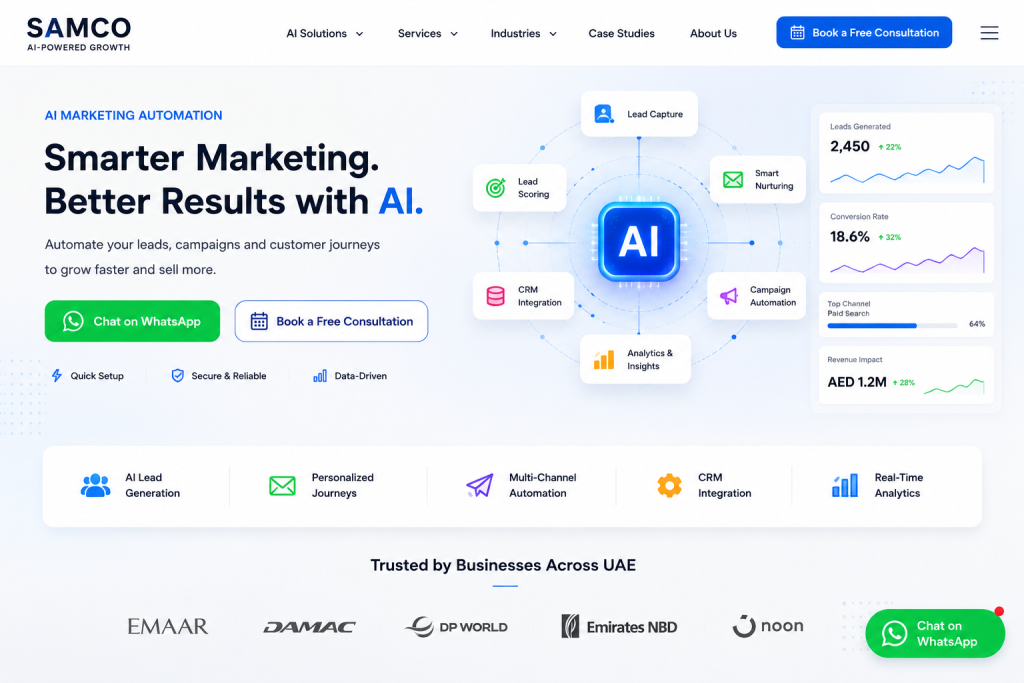
What Is AI Marketing Automation?
AI marketing automation combines marketing automation workflows with artificial intelligence to support selected marketing activities using business data, customer information, behavioural signals, defined rules, and AI capabilities.
Traditional marketing automation can execute predefined actions when specific conditions are met. AI can add capabilities such as analysing information, identifying patterns, supporting lead prioritisation, assisting with personalisation, and generating insights from marketing data.
AI in marketing automation can therefore support different stages of the customer journey, including:
Lead capture
Lead qualification
Lead scoring
Lead nurturing
Customer segmentation
Personalised communication
Campaign workflows
CRM updates
Customer re-engagement
Marketing reporting
Performance analysis
The right level of AI depends on the business objective, available data, marketing systems, customer journey, and the workflow being automated.
AI Marketing Automation Services
SAMCO helps businesses identify, design, implement, integrate, and improve AI-powered marketing workflows.
AI Lead Generation Automation
Lead generation often involves several repetitive activities between the first customer interaction and the point where a sales team receives a qualified opportunity.
AI marketing automation can support:
Lead capture from connected channels
Lead information collection
Lead qualification
Lead scoring
Lead routing
Follow-up triggers
CRM updates
Sales-team notifications
The workflow can be designed around the business’s qualification criteria and customer journey.
AI Lead Nurturing
Not every lead is ready to speak with a sales representative immediately.
Automated nurturing can help businesses maintain relevant communication with leads based on their stage, actions, interests, or available customer information.
A nurturing workflow may include:
Initial follow-up
Educational communication
Reminder messages
Re-engagement
Behaviour-based triggers
Sales handoff
Customer-status updates
The objective is to reduce manual follow-up while keeping the customer journey structured and relevant.
AI Campaign Automation
Marketing teams can automate selected campaign activities instead of manually executing every step.
Depending on the campaign, automation can support:
Audience selection
Campaign triggers
Customer segmentation
Personalised communication
Follow-up sequences
Campaign notifications
Performance monitoring
Reporting
AI capabilities can be incorporated where they provide a clear benefit to the campaign workflow.
AI CRM Marketing Automation
Your CRM can become an important part of an automated marketing process.
AI marketing automation can connect suitable marketing activities with CRM workflows such as:
Lead scoring
Lead assignment
Customer segmentation
Lifecycle stages
Follow-up triggers
Sales handoff
Pipeline updates
Customer re-engagement
The exact integration depends on the CRM, available APIs, data structure, permissions, and business requirements.
AI Marketing Reporting
Marketing teams often spend significant time collecting information from different platforms and preparing reports.
Automation can help bring relevant marketing information together and support:
Campaign reporting
Lead performance
Conversion analysis
Engagement reporting
Customer journey analysis
Marketing performance summaries
This gives teams a clearer view of what is happening across their marketing workflows.
What Can AI Marketing Automation Automate?
The best automation depends on your marketing process. Common areas include:
| Marketing activity | What automation can support |
|---|---|
| Lead capture | Collect and route incoming leads |
| Lead qualification | Apply defined qualification criteria |
| Lead scoring | Prioritise leads using selected signals |
| Lead nurturing | Trigger relevant follow-up sequences |
| Customer segmentation | Organise customers according to available data |
| Email workflows | Automate suitable communication sequences |
| WhatsApp workflows | Support approved customer follow-up processes |
| CRM workflows | Update and trigger selected CRM actions |
| Campaign workflows | Connect triggers, conditions, and actions |
| Reporting | Automate recurring marketing information and analysis |
| Re-engagement | Trigger campaigns for selected inactive customers |
Automation should always be designed around the actual business process. Not every marketing task needs AI, and not every workflow should be fully automated.
AI-Powered Lead Generation and Nurturing
A strong marketing automation system should connect lead generation with what happens after the lead arrives.
Capture the Lead
Leads may come through:
Website forms
Landing pages
Advertising campaigns
Website interactions
Connected marketing channels
Other approved lead sources
The automation can transfer relevant information into the appropriate system.
Qualify the Lead
The workflow can apply business-defined criteria to help determine whether a lead should be prioritised.
Criteria may include:
Business type
Customer requirements
Location
Product or service interest
Engagement
Previous interactions
Lead stage
Score and Prioritise
Lead scoring can help marketing and sales teams distinguish between different levels of interest.
Where appropriate, AI can assist with analysing available signals while predefined business rules maintain control over the process.
Nurture the Lead
Leads that are not ready for immediate sales contact can enter appropriate nurture workflows.
These workflows can use different actions based on customer behaviour and lifecycle stage.
Send Qualified Leads to Sales
When a lead meets the defined criteria, the automation can:
Update the CRM
Notify the sales team
Assign the lead
Trigger an appointment workflow
Start an appropriate sales process
This creates a more structured transition from marketing to sales.
AI Marketing Automation for CRM
CRM integration is important when marketing information needs to connect with sales activity.
An AI marketing automation implementation can support workflows around:
Lead Management
Capture, classify, score, assign, and track leads.
Customer Segmentation
Use available customer information to create relevant audience groups.
Lifecycle Automation
Trigger different actions according to where a customer is in the journey.
Sales Handoff
Send qualified opportunities to the appropriate sales process.
Follow-Up
Create structured follow-up workflows so suitable leads are not forgotten.
Customer Re-Engagement
Identify appropriate customer segments for re-engagement campaigns.
The integration should respect the CRM’s data structure, permissions, available APIs, and business processes.
AI Marketing Automation for Email and WhatsApp
Email and WhatsApp can be important communication channels for businesses in the UAE.
Email Marketing Automation
Automation can support:
Welcome sequences
Lead nurturing
Follow-up
Customer onboarding
Re-engagement
Lifecycle communication
Campaign notifications
Messages should be based on the customer’s stage and the purpose of the workflow.
WhatsApp Marketing Automation
Where appropriate infrastructure and approved business integrations are available, automation can support:
Lead follow-up
Customer enquiries
Qualification
Reminders
Appointment-related communication
Customer updates
Human handoff
Automation should not replace human support when a customer requires a complex response or direct assistance.
AI-Powered Marketing Personalisation
Personalisation means delivering more relevant communication based on available customer information.
AI-assisted marketing workflows can use suitable information such as:
Customer segment
Previous interactions
Lead stage
Product or service interest
Engagement
Customer lifecycle
This can help businesses create different journeys instead of sending identical communication to every customer.
The quality of personalisation depends on the quality, accuracy, availability, and permitted use of the underlying data.
AI Campaign Optimisation
Marketing automation can also support campaign performance analysis.
Depending on the available platforms and data, businesses can monitor:
Campaign engagement
Lead quality
Conversion activity
Audience performance
Customer responses
Campaign trends
AI can assist with identifying patterns or generating recommendations, while marketing teams retain control over important business decisions.
AI Marketing Automation for Different Businesses
AI marketing automation can be adapted to different business models.
B2B Businesses
B2B companies can use automation for:
Lead capture
Lead qualification
Lead scoring
Long-term nurturing
CRM updates
Sales handoff
E-commerce Businesses
E-commerce workflows can support:
Customer segmentation
Product-related communication
Abandoned-cart workflows
Re-engagement
Customer lifecycle campaigns
Real Estate Businesses
Real estate marketing automation can support:
Property enquiry capture
Lead qualification
Follow-up
Customer segmentation
Sales-team routing
Service Businesses
Service companies can automate:
Enquiry capture
Lead follow-up
Appointment-related workflows
Customer re-engagement
CRM updates
The workflow should be designed around the actual customer journey rather than forcing every business into the same automation model.
AI Marketing Automation Tools and Integrations
AI marketing automation can connect different parts of a marketing technology stack when suitable integrations are available.
Depending on your requirements, this may include:
CRM systems
Websites
Email platforms
Advertising platforms
Analytics systems
Customer databases
Marketing platforms
APIs
Internal business applications
The right technology depends on your existing systems and what the automation needs to accomplish.
Before implementation, we assess:
Available integrations
Data sources
API capabilities
User permissions
Security requirements
Workflow requirements
Reporting requirements
This helps prevent an automation project from becoming disconnected from the systems your team already uses.
How AI Marketing Automation Works
A practical AI marketing automation workflow can be structured into seven stages.
1. Capture
Relevant customer or lead information enters the marketing system.
2. Understand
Available data and customer signals are evaluated.
3. Decide
The workflow applies business rules and, where appropriate, AI-supported analysis.
4. Trigger
The appropriate marketing action is activated.
5. Personalise
The customer receives relevant communication based on the workflow.
6. Measure
The business tracks engagement, lead quality, conversion, and other selected metrics.
7. Optimise
The workflow is reviewed and improved using performance information.
This structure keeps AI connected to a measurable marketing process rather than using AI as an isolated feature.
Our AI Marketing Automation Process
SAMCO follows a structured process to identify where AI marketing automation can provide practical value.
Step 1: Understand Your Marketing Process
We review:
Current marketing activities
Lead sources
Customer journey
CRM
Communication channels
Existing automation
Reporting
Step 2: Identify Automation Opportunities
We identify repetitive, time-consuming, or information-heavy marketing activities that may be suitable for automation.
Step 3: Map the Customer Journey
We define the journey from:
Lead → Qualification → Nurturing → Conversion → Retention
This helps determine where automation should begin and where human involvement is required.
Step 4: Design the Workflow
We define:
Triggers
Conditions
Actions
Data
AI capabilities
Integrations
Human handoffs
Step 5: Integrate the Required Systems
Relevant marketing and business systems are connected where technically and operationally appropriate.
Step 6: Test
We test:
Workflow logic
Data transfer
Integrations
Lead routing
Messages
Tracking
Error conditions
Step 7: Deploy
The approved workflow is deployed into the intended business environment.
Step 8: Optimise
After deployment, performance can be reviewed using relevant marketing KPIs and workflow data.
AI Marketing Automation for UAE Businesses
UAE businesses can have different customer journeys, communication preferences, marketing channels, and technology environments.
An AI marketing automation system can be designed around requirements such as:
UAE customer journeys
English and Arabic communication where required
WhatsApp-based customer interactions
CRM integration
Website lead generation
Advertising lead flows
Customer segmentation
Business reporting
The implementation should reflect the actual requirements of the business rather than assuming that one automation model works for every UAE company.
Benefits of AI Marketing Automation
Reduce Manual Marketing Work
Automate suitable repetitive tasks so marketing teams can spend more time on strategy and customer-focused work.
Improve Follow-Up
Structured workflows can reduce the chance of suitable leads being missed during manual follow-up.
Prioritise Leads
Lead scoring and defined signals can help teams focus attention on higher-priority opportunities.
Improve Customer Journeys
Customers can receive different communications based on their stage and relevant interactions.
Connect Marketing and Sales
CRM-connected workflows can create a more structured transition between marketing and sales.
Improve Marketing Visibility
Automated reporting can make important campaign and lead information easier to review.
Scale Marketing Operations
Businesses can manage more structured workflows without manually executing every individual action.
AI Marketing Automation vs Traditional Marketing Automation
Traditional marketing automation primarily relies on predefined rules and workflows.
AI marketing automation can combine those workflows with AI capabilities where they provide practical value.
| Traditional automation | AI marketing automation |
|---|---|
| Predefined rules | Rules combined with AI capabilities where appropriate |
| Fixed workflows | Workflows that can use additional data and signals |
| Manual analysis | AI-assisted analysis |
| Scheduled communication | Behaviour- or condition-triggered communication |
| Manual reporting | Automated reporting and analysis |
| Fixed customer journeys | More adaptive journeys where data supports them |
AI does not automatically improve every marketing workflow. Good results depend on the quality of the process, data, integrations, implementation, and ongoing optimisation.
Measuring AI Marketing Automation ROI
A marketing automation project should have measurable objectives.
Relevant KPIs can include:
Lead response time
Qualified lead volume
Lead-to-opportunity rate
Conversion rate
Customer engagement
Cost per qualified lead
Customer acquisition cost
Sales pipeline influenced
Revenue influenced
Marketing team time saved
The appropriate KPIs should be established before implementation so that the business can evaluate whether the automation is achieving its intended purpose.
Why Choose SAMCO for AI Marketing Automation?
SAMCO approaches AI marketing automation from the business process first.
We focus on understanding what your marketing team currently does, identifying suitable automation opportunities, designing the workflow, connecting relevant systems, testing the implementation, and improving the process after deployment.
Our approach includes:
Business-focused automation planning
Marketing workflow analysis
Custom workflow design
CRM and system integration
AI-assisted marketing processes
Structured testing
Tracking and measurement
Ongoing optimisation
The goal is a practical marketing automation system that fits your business rather than a generic collection of AI features.
AI Marketing Automation FAQs
What is AI marketing automation?
AI marketing automation combines marketing automation workflows with artificial intelligence to support activities such as lead generation, qualification, nurturing, personalisation, campaign management, CRM workflows, and marketing analysis.
How does AI in marketing automation work?
AI can be incorporated into marketing workflows to analyse available information, support lead prioritisation, assist with personalisation, identify patterns, and provide insights while predefined business rules control important workflow actions.
What can AI marketing automation automate?
It can support lead capture, qualification, lead scoring, nurturing, customer segmentation, email workflows, WhatsApp workflows, CRM actions, campaign workflows, reporting, and selected re-engagement activities.
Can AI marketing automation integrate with a CRM?
Yes. Where the CRM provides suitable APIs or integration capabilities, marketing workflows can be connected with lead records, customer data, lifecycle stages, assignments, and other appropriate CRM activities.
Can AI marketing automation work with WhatsApp?
It can support appropriate WhatsApp marketing workflows where the required business infrastructure, approved integrations, APIs, permissions, and workflow requirements are available.
Can AI marketing automation generate and nurture leads?
Yes. Automation can support lead capture, qualification, scoring, routing, and nurturing. Actual lead quality and conversion depend on targeting, marketing strategy, data, messaging, and the overall customer journey.
Is AI marketing automation suitable for small businesses?
It can be suitable when the expected business value justifies the implementation. The appropriate solution depends on lead volume, workflow complexity, available systems, data, and the amount of manual work that can realistically be reduced.
How much does AI marketing automation cost in the UAE?
There is no single fixed price. Cost depends on the number and complexity of workflows, required integrations, data requirements, channels, development or configuration work, testing, and ongoing optimisation.
How long does AI marketing automation take to implement?
Implementation time depends on the existing marketing systems, number of workflows, integration requirements, data preparation, testing, and project scope.
What is the difference between AI automation and AI marketing automation?
AI automation is a broader category covering business and operational processes. AI marketing automation focuses specifically on marketing activities such as lead generation, nurturing, campaigns, customer journeys, CRM marketing workflows, and marketing reporting.
Does every marketing process need AI?
No. Some processes are better handled through straightforward rule-based automation. AI should be introduced where it provides a practical benefit and where the available data and systems can support it.
Start Your AI Marketing Automation Project
If your marketing team spends too much time on lead follow-up, customer segmentation, campaign workflows, CRM updates, reporting, or repetitive marketing tasks, the first step is to identify which processes are suitable for automation.
SAMCO can assess your existing marketing workflow and help define an AI marketing automation approach around your business objectives, systems, data, and customer journey.
Discuss Your Marketing Automation Requirement
Get an AI Marketing Automation Strategy


