

AI Face Recognition Solutions for Smarter, More Secure Business Operations
Strengthen security and streamline identity verification with enterprise Face Recognition solutions powered by Artificial Intelligence, Computer Vision, and AI Video Analytics. Samco helps organizations across the UAE identify authorized individuals in real time, automate access control, improve visitor management, and support faster security decisions using existing CCTV and IP camera infrastructure.
Whether you manage a corporate office, healthcare facility, educational campus, government site, airport, or smart building, our AI Face Recognition technology delivers accurate identification while reducing manual verification and enhancing operational efficiency. Every deployment is designed around your security requirements, compliance needs, and existing surveillance environment.
What is AI Face Recognition?
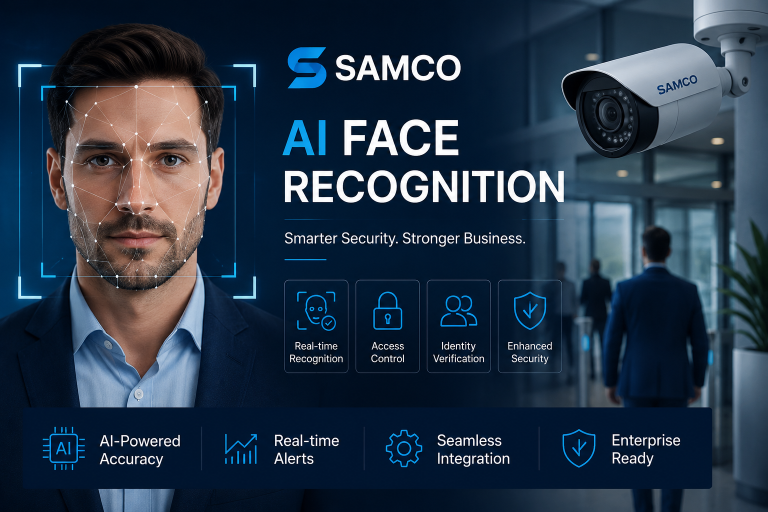
AI Face Recognition is a computer vision technology that automatically detects, analyzes, and identifies or verifies individuals by comparing unique facial characteristics captured from images or live video. When combined with AI Video Analytics, it enables organizations to automate identity verification, strengthen access control, and improve security without relying solely on manual monitoring.
Unlike traditional surveillance systems that only record video, a Face Recognition System interprets visual data in real time. Using Artificial Intelligence, Machine Learning, and Deep Learning, it converts facial features into secure digital templates and compares them against authorized databases. This allows security teams to quickly verify identities, detect unauthorized access attempts, and respond to incidents more efficiently.
Modern Face Recognition Software can be deployed with existing CCTV cameras and IP camera networks, making it a practical solution for businesses looking to enhance security without replacing their current infrastructure. Depending on operational requirements, the technology can support employee access management, visitor authentication, attendance verification, and restricted area monitoring while maintaining high levels of accuracy.
For enterprise organizations, the value extends beyond identification. AI-powered facial recognition helps reduce manual verification processes, improves operational efficiency, provides consistent identity checks across multiple locations, and delivers actionable insights that support better security and business decisions.
How AI Face Recognition Works
An AI Face Recognition system follows a structured process that enables fast and reliable identity verification from live video streams or recorded footage. By combining Computer Vision, Artificial Intelligence, and advanced facial analysis, the system continuously monitors video feeds and identifies individuals in real time.
1. Face Detection
The system first scans video from CCTV or IP cameras to detect the presence of a human face. It distinguishes faces from other objects and automatically locates them, even in environments with multiple people or continuous movement.
2. Facial Feature Analysis
Once a face is detected, the software analyzes unique facial characteristics—such as the distance between the eyes, nose shape, jawline, and other distinguishing features. These characteristics are converted into a secure biometric template rather than storing a simple image for comparison.
3. Identity Matching
The biometric template is compared against an authorized database to verify or identify the individual. Depending on the deployment, the system can confirm employee identities, recognize approved visitors, or detect unknown individuals entering restricted areas.
4. Real-Time Alerts and Actions
When a match or predefined event is detected, the system can trigger automated responses. These may include notifying security personnel, generating alerts, logging access events, unlocking authorized entry points, or flagging unauthorized access attempts for immediate review.
5. Continuous Learning and Monitoring
Modern Face Recognition Software uses AI models that improve recognition performance across varying lighting conditions, camera angles, and facial appearances. Combined with AI Video Analytics, the solution continuously analyzes live video to provide consistent identity verification and support faster operational decisions.
By integrating with existing surveillance infrastructure, businesses can automate identity verification without disrupting current security operations, making deployment both practical and scalable for enterprise environments.
Business Benefits of AI Face Recognition
Implementing AI Face Recognition provides more than automated identity verification. It helps organizations strengthen security, improve operational efficiency, and make faster, data-driven decisions. When integrated with AI Video Analytics, businesses can reduce manual processes while maintaining consistent and reliable access control across multiple locations.
Enhance Security and Access Control
Verify identities in real time and prevent unauthorized access to restricted areas. Automated recognition reduces reliance on manual checks, helping security teams respond more quickly to potential threats.
Improve Operational Efficiency
Manual identity verification can slow down daily operations. A Face Recognition System automates authentication for employees, visitors, and authorized personnel, allowing staff to focus on higher-value tasks while reducing waiting times.
Faster Incident Response
When the system detects an unauthorized individual or matches a person on a watchlist, it can immediately generate alerts for security personnel. Faster notifications enable quicker investigation and response, helping minimize security risks.
Seamless Integration with Existing Infrastructure
Many organizations can deploy Face Recognition Software using their current CCTV and IP camera network. This reduces implementation complexity and allows businesses to enhance security without a complete infrastructure replacement.
Consistent Identity Verification Across Locations
For enterprises operating multiple offices, facilities, or campuses, AI-powered recognition applies the same verification standards across every site. This improves security governance while simplifying centralized monitoring and reporting.
Scalable for Growing Organizations
Whether securing a single building or a large enterprise with multiple facilities, AI-based facial recognition solutions can scale as operational requirements evolve. Additional cameras, locations, and user databases can be incorporated without redesigning the entire security ecosystem.
By combining Artificial Intelligence, Computer Vision, and enterprise surveillance systems, organizations gain a practical solution that improves security, supports compliance objectives, and delivers long-term operational value.
Key Features of AI Face Recognition Solutions
An enterprise Face Recognition solution should do more than identify individuals. It should integrate with existing security infrastructure, deliver reliable performance in real-world environments, and provide actionable information that supports daily operations. Samco’s solutions are designed to help organizations deploy scalable, intelligent identity verification across a wide range of business environments.
Real-Time Face Recognition
Identify and verify individuals from live CCTV and IP camera feeds as events occur. Real-time recognition enables faster decision-making and allows security teams to respond immediately to unauthorized access or security incidents.
Accurate Identity Verification
Advanced AI Face Recognition algorithms analyze unique facial characteristics to distinguish between individuals with a high level of accuracy. Performance is optimized for varying lighting conditions, camera angles, and busy environments commonly found in enterprise facilities.
Access Control Integration
Integrate facial recognition with existing access control systems to automate entry for authorized employees, contractors, and visitors. This reduces manual verification while improving security at entrances, restricted areas, and critical infrastructure.
Watchlist and Alert Management
Create watchlists for authorized personnel, restricted individuals, or persons of interest. When a match is detected, the system can automatically notify security teams, record the event, and support a faster response.
Multi-Camera and Multi-Site Monitoring
Monitor identities across multiple cameras, buildings, or locations from a centralized platform. This is particularly valuable for organizations managing corporate campuses, government facilities, healthcare networks, airports, or distributed operations.
Event Logging and Audit Trails
Every recognition event can be securely recorded with timestamps, camera details, and verification results. These records help organizations review incidents, support investigations, and maintain operational accountability.
Flexible Deployment Options
Face recognition solutions can be deployed on-premises, in the cloud, or through hybrid environments, depending on security policies, infrastructure, and compliance requirements. This flexibility allows businesses to choose an architecture that aligns with their operational and data governance needs.
Industry Applications of AI Face Recognition
AI Face Recognition supports a wide range of industries where accurate identity verification, controlled access, and efficient security operations are essential. By integrating with existing CCTV and security infrastructure, organizations can automate routine processes while improving safety and operational oversight.
Corporate Offices
Verify employee identities, manage visitor access, and secure restricted areas without relying on manual identity checks. Automated authentication helps improve workplace security while creating a smoother experience for employees and guests.
Government and Public Sector
Government facilities often require strict access control and continuous monitoring. Face recognition helps verify authorized personnel, strengthen facility security, and support compliance with established security protocols.
Healthcare Facilities
Hospitals and healthcare centers can use facial recognition to manage access to sensitive departments, laboratories, pharmacies, and administrative areas. Automated identity verification helps protect patients, staff, and confidential information while reducing manual verification processes.
Educational Institutions
Schools, universities, and research campuses can improve campus security by verifying authorized staff, students, and approved visitors. The technology also supports controlled access to laboratories, libraries, and other restricted facilities.
Airports and Transportation Hubs
High-traffic environments benefit from fast, automated identity verification. Face recognition can assist with access management for employees, support passenger processing workflows, and enhance overall security monitoring across terminals and operational areas.
Smart Buildings and Commercial Facilities
Modern commercial buildings use AI-powered facial recognition to simplify access management, improve tenant security, and monitor authorized entry across multiple access points. Centralized management also helps facility teams oversee security across multiple locations.
Manufacturing, Warehousing, and Logistics
Industrial facilities can restrict access to production zones, warehouses, and high-risk operational areas by verifying personnel before entry. Automated identity checks improve workplace safety while maintaining operational efficiency across large sites.
Regardless of the industry, a well-planned Face Recognition System should be tailored to operational requirements, existing infrastructure, and applicable privacy regulations to deliver reliable long-term performance.
Integration with Existing CCTV Systems
One of the biggest advantages of an enterprise AI Face Recognition solution is its ability to work with existing surveillance infrastructure. In many cases, organizations can enhance their security capabilities without replacing their current CCTV cameras or video management systems, making implementation faster and more cost-effective.
Leverage Your Existing Camera Network
Most modern Face Recognition Software can integrate with compatible IP cameras and CCTV systems already deployed across offices, factories, warehouses, healthcare facilities, educational institutions, and government sites. This allows businesses to add intelligent identity verification while maximizing the value of their existing investment.
Connect with Access Control Systems
AI-powered facial recognition can integrate with access control platforms to automate entry for authorized personnel. Once an individual’s identity is verified, the system can trigger predefined actions such as unlocking secure doors, recording access events, or notifying security teams if verification fails.
Centralized Security Management
Organizations operating multiple locations can manage face recognition events through a centralized interface. Security teams gain a unified view of identity verification, access logs, and alerts across all connected sites, enabling consistent security policies and simplified administration.
Support for Enterprise Security Ecosystems
A well-designed Face Recognition System can become part of a broader security ecosystem by integrating with video management software (VMS), access control platforms, alarm systems, and other enterprise security technologies. This creates a coordinated response to security events and improves overall operational visibility.
Scalable for Future Expansion
As security requirements evolve, additional cameras, facilities, users, and recognition databases can be incorporated without redesigning the entire solution. This scalability allows organizations to expand their security capabilities while maintaining consistent performance across growing operations.
Successful integration begins with evaluating your existing infrastructure, operational objectives, and compliance requirements. A structured deployment approach helps ensure the solution delivers accurate identification, reliable performance, and long-term value.
Privacy & Security Considerations
Implementing AI Face Recognition requires more than technical accuracy. Organizations must also ensure that identity verification is carried out responsibly, with appropriate safeguards for personal data, privacy, and information security. A well-designed solution balances operational efficiency with compliance and transparency.
Protect Biometric Data
Facial recognition systems should securely process and store biometric information using industry-standard encryption and access controls. Limiting access to authorized personnel and maintaining secure data management practices helps reduce the risk of unauthorized access or data misuse.
Support Privacy and Regulatory Requirements
Before deploying a Face Recognition System, organizations should evaluate the privacy regulations and industry requirements that apply to their operations. Clear policies for data collection, retention, and deletion help support compliance while building trust with employees, visitors, and customers.
Define Appropriate Use Cases
Face recognition is most effective when implemented for clearly defined business purposes, such as access control, identity verification, visitor management, or restricted area monitoring. Establishing documented policies helps ensure the technology is used consistently and responsibly across the organization.
Maintain Accuracy Through Ongoing Management
Recognition performance depends on factors such as camera placement, image quality, lighting conditions, and the quality of enrolled facial data. Regular system testing, software updates, and database maintenance help maintain reliable performance as operational environments change.
Implement Role-Based Access and Audit Logs
Administrative access should be restricted to authorized users, with all system activities recorded through audit logs. Maintaining detailed records of configuration changes, user access, and recognition events supports internal governance, security reviews, and incident investigations.
Build Trust Through Transparent Deployment
Successful implementation includes informing relevant stakeholders about how the technology is used, what data is processed, and the security measures in place to protect it. Transparency, combined with strong technical controls, helps organizations deploy AI-powered facial recognition responsibly while supporting long-term business objectives.
Deployment Options
Every organization has different security, infrastructure, and compliance requirements. An enterprise AI Face Recognition solution should offer flexible deployment options that align with existing IT environments while supporting future growth and operational needs.
On-Premises Deployment
Organizations with strict security policies or internal data management requirements often choose an on-premises deployment. The Face Recognition System operates within the organization’s own infrastructure, giving IT teams greater control over system configuration, data storage, and network access.
Cloud Deployment
Cloud-based deployment provides centralized management without requiring extensive on-site infrastructure. It can simplify software updates, system administration, and multi-site management, making it suitable for organizations that need to monitor multiple locations from a single platform.
Hybrid Deployment
A hybrid approach combines on-premises infrastructure with cloud-based management or analytics. This option allows businesses to keep sensitive data within their own environment while benefiting from centralized monitoring, remote administration, or scalable processing where appropriate.
Edge AI Processing
For environments that require low-latency performance, AI processing can be performed at the edge using compatible cameras or local edge devices. Processing recognition tasks closer to the video source reduces response times, minimizes bandwidth usage, and supports real-time identity verification even in distributed environments.
Integration with Existing Enterprise Systems
A successful deployment extends beyond camera integration. Depending on operational requirements, Face Recognition Software can integrate with video management systems (VMS), access control platforms, visitor management solutions, security information systems, and enterprise identity management workflows to create a connected security ecosystem.
Deployment Planning and Ongoing Support
Before implementation, organizations should assess camera coverage, network capacity, operational workflows, and compliance requirements. A structured deployment plan—covering system design, installation, testing, user training, and ongoing maintenance—helps ensure reliable performance and long-term operational value.
Implementation Process
A successful AI Face Recognition deployment begins with understanding your operational requirements and existing security infrastructure. Following a structured implementation process helps ensure the solution integrates smoothly, performs reliably, and delivers measurable business value from day one.
1. Requirements Assessment
The process starts with evaluating your security objectives, facility layout, existing CCTV infrastructure, access control systems, and operational workflows. This assessment helps determine where facial recognition will provide the greatest value and identifies any technical or compliance considerations before deployment.
2. Solution Design
Based on the assessment, a deployment plan is developed that defines camera coverage, recognition zones, system architecture, user enrollment, integration requirements, and performance objectives. The solution is designed to meet your organization’s security policies while supporting future scalability.
3. System Integration
The Face Recognition System is integrated with compatible CCTV cameras, IP cameras, access control platforms, and video management systems. Configuration and testing ensure the solution operates seamlessly within your existing security environment without disrupting daily operations.
4. Testing and Optimization
Before the system goes live, recognition accuracy, alert workflows, camera positioning, and system performance are validated under real operating conditions. Fine-tuning at this stage helps improve reliability and ensures the solution performs consistently across different environments.
5. User Training and Go-Live
Security personnel and system administrators receive guidance on day-to-day operation, user management, monitoring, reporting, and incident handling. Proper training enables teams to use the platform effectively and maximize its operational benefits.
6. Ongoing Support and Maintenance
Regular software updates, system health checks, performance reviews, and technical support help maintain long-term accuracy and reliability. As business needs evolve, the solution can be expanded to support additional locations, cameras, users, and security requirements.
A phased and well-managed implementation reduces deployment risks, accelerates user adoption, and ensures the AI Face Recognition solution continues to deliver value as your organization grows.
Why Choose Samco for AI Face Recognition Solutions?
Selecting the right implementation partner is just as important as choosing the technology itself. A successful AI Face Recognition solution must align with your security objectives, integrate with your existing infrastructure, and remain reliable as your organization grows. Samco focuses on delivering enterprise-ready solutions that address practical business challenges rather than offering a one-size-fits-all approach.
Enterprise-Focused Solution Design
Every organization has unique operational requirements. Samco evaluates your existing CCTV infrastructure, access control processes, and security objectives to recommend a solution that fits your environment and supports long-term scalability.
Expertise in AI Video Analytics
Face recognition is one component of a broader intelligent surveillance strategy. Our experience with AI Video Analytics, Computer Vision, and enterprise security solutions enables us to design integrated systems that improve visibility, automate monitoring, and support faster decision-making.
Seamless System Integration
Rather than replacing existing investments, we focus on integrating face recognition with compatible CCTV cameras, IP cameras, video management systems, and access control platforms. This approach minimizes disruption while helping organizations maximize the value of their current security infrastructure.
Deployment, Training, and Ongoing Support
From initial planning through implementation and post-deployment support, Samco works with your team to ensure the solution operates effectively. We provide guidance on system configuration, user training, optimization, and ongoing maintenance to help maintain reliable performance over time.
Built for Enterprise Growth
As business requirements evolve, your security platform should be able to grow with them. Our solutions are designed to support additional sites, users, cameras, and security workflows, allowing organizations to expand without rebuilding their entire surveillance ecosystem.
If you’re planning to implement AI Face Recognition for access control, identity verification, or intelligent surveillance, our specialists can help you evaluate the right approach based on your operational goals and existing infrastructure.
Frequently Asked Questions (FAQs)
What is AI Face Recognition?
AI Face Recognition is a technology that uses Artificial Intelligence and Computer Vision to identify or verify individuals by analyzing unique facial characteristics from images or live video. It helps organizations automate identity verification, strengthen access control, and improve security operations.
How does AI Face Recognition work?
The system detects a face, extracts unique facial features, converts them into a secure biometric template, and compares that template with authorized records. If a match is found, the system can trigger predefined actions such as granting access, recording the event, or notifying security personnel.
Can Face Recognition work with existing CCTV cameras?
Yes. Many enterprise Face Recognition Systems are designed to integrate with compatible CCTV and IP camera infrastructure. The exact integration depends on your existing hardware, video management system, and operational requirements.
Is AI Face Recognition accurate?
Modern Face Recognition Software can achieve high levels of accuracy when deployed with appropriate camera placement, image quality, lighting conditions, and properly maintained facial databases. Regular system updates and performance monitoring also help maintain reliable results.
Is Face Recognition secure?
When implemented correctly, facial recognition systems use encryption, access controls, audit logs, and secure data management practices to protect biometric information. Organizations should also establish clear policies for data handling and comply with applicable privacy regulations.
Which industries benefit from Face Recognition?
Face recognition is widely used across corporate offices, government facilities, healthcare organizations, educational institutions, airports, manufacturing sites, warehouses, logistics operations, commercial buildings, and other environments where secure identity verification and controlled access are essential.
Can the system be integrated with access control solutions?
Yes. AI-powered facial recognition can integrate with compatible access control systems to automate entry for authorized personnel, improve visitor management, and strengthen security for restricted areas.
How long does implementation take?
Deployment timelines vary depending on factors such as the number of locations, camera infrastructure, integration requirements, and project scope. Following an initial assessment, an implementation plan can be developed with a realistic deployment schedule.
What support does Samco provide after deployment?
Samco provides support throughout the implementation lifecycle, including solution planning, system integration, configuration, testing, user training, optimization, and ongoing technical maintenance to help ensure reliable long-term performance.
How can I request a consultation?
You can contact Samco to discuss your security objectives, existing infrastructure, and operational requirements. Our specialists will assess your needs and recommend an AI Face Recognition solution that aligns with your business goals.
Secure Your Business with Enterprise AI Face Recognition
Whether you’re planning to strengthen access control, automate identity verification, or enhance your existing surveillance system, the right AI Face Recognition solution starts with a clear understanding of your operational and security requirements.
Samco works with organizations across the UAE to design and implement enterprise-ready solutions that integrate with existing CCTV infrastructure, support scalable deployments, and align with business and compliance objectives. Our specialists will evaluate your environment, discuss your use cases, and recommend a solution tailored to your organization.
Get a Free Face Recognition Consultation to explore how AI-powered facial recognition can improve security, streamline operations, and support smarter decision-making.
Or, if you’d like to see the technology in action, Request a Live Demo to understand how the solution fits your existing infrastructure and business workflows.


